hnRNPK Condensate-Mediated 3D Transcriptional Regulation: A Mechanism Mimicking Water Droplets to Activate Gene Switches
Background
An enduring mystery in gene expression regulation. Traditionally, molecular biology has focused on transcription factors that bind to specific DNA sequences to regulate gene transcription. However, the specific roles of RNAs transcribed from non-coding regions, which comprise more than 90% of the human genome, remain largely unknown. In particular, the principle by which enhancers and promoters overcome long distances to form 3D looped structures has been a mystery.
The limitations of the chromatin loop structure model. Previous studies have attempted to explain 3D looping models based on proteins that support the chromatin structure within cells. However, it has been difficult to fully explain the precise gene activation patterns observed in cell differentiation or in response to external stimuli solely through the actions of these proteins. Recently, the scientific community has focused on the phenomenon of liquid-liquid phase separation (LLPS), in which proteins and RNAs aggregate like water droplets.
Key Findings
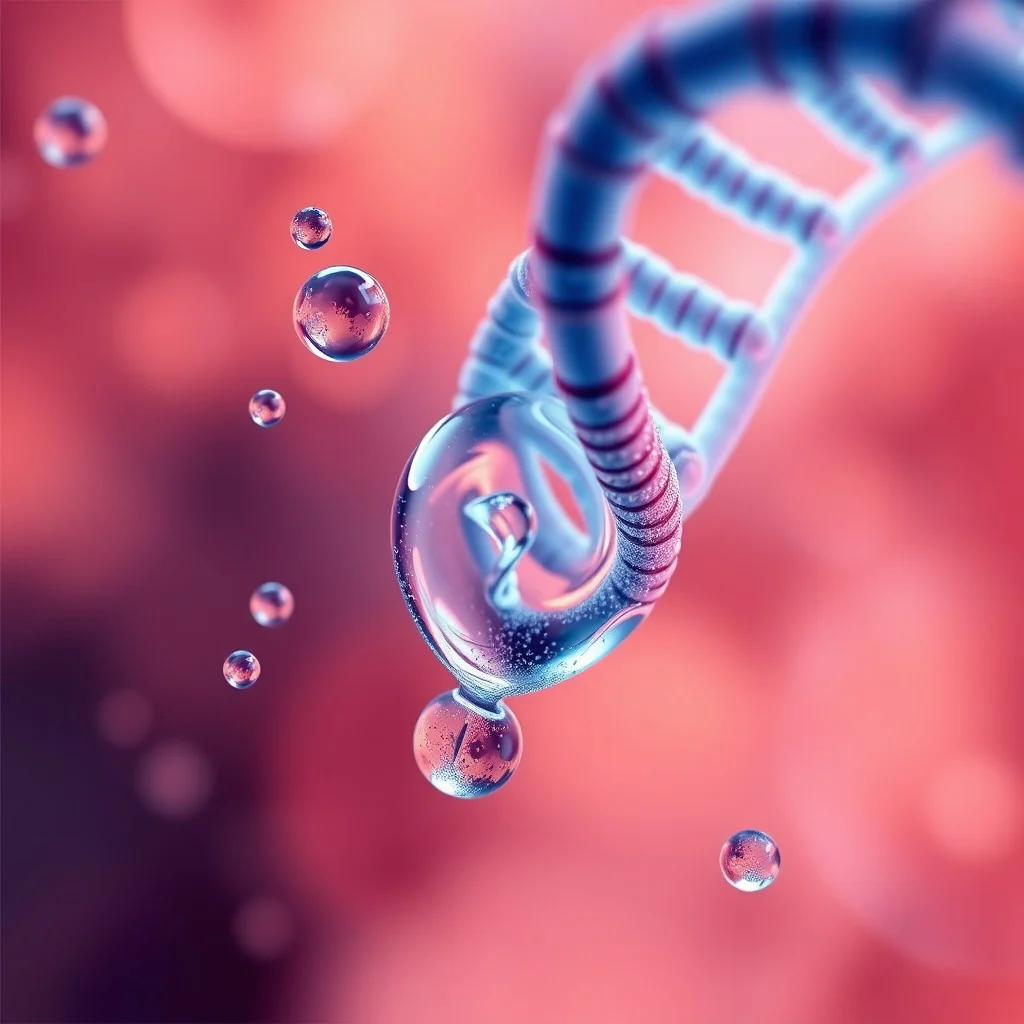
Protein droplets build gene transcription hubs. A joint research team from the Institute of Biophysics, Chinese Academy of Sciences, led by Dr. Xuechao Su, and the Southern Medical University, led by Professor Ping Zhou, has identified that RNA-binding protein heterogeneous nuclear ribonucleoprotein K (hnRNPK) is a key molecule in 3D genome transcriptional regulation. The team utilized their self-developed RNA in situ conformation sequencing (RIC-seq) technique, along with chromatin high-order structure analysis (HiChIP) and protein-DNA interaction analysis (CUT&Tag) technologies. The results showed that hnRNPK protein simultaneously binds to enhancer RNA (eRNA) in the enhancer region and promoter upstream transcript RNA (uaRNA) around the promoter. This multi-RNA binding alters the physical properties of the hnRNPK protein, inducing LLPS. Protein molecules aggregate densely to form a unique liquid-like condensate with fine voids inside. The formed condensate functions as a highly efficient transcriptional regulation hub within the cell. Specifically, it directly contacts RPB3, a key subunit of RNA Polymerase II (Pol II), and recruits the entire enzyme into the condensate. Finally, the hnRNPK condensate connects enhancers and promoters, completing the loop structure and mobilizing the trapped Pol II to the promoter to initiate transcription.
A close association with the rare Au-Kline syndrome. The research team validated this mechanism using cases of Au-Kline syndrome (AKS), a congenital rare genetic disorder. Mutations in the HNRNPK gene block the normal aggregation process of hnRNPK protein. This mutant protein exhibits abnormal phase transitions, becoming fluid and aggregating into sticky gels or solid forms. Consequently, the coagulated protein interferes with chromatin loop formation, physically blocking the recruitment of Pol II. As a result, gene transcription essential for embryonic development and the formation of bones and the heart is completely halted. In the AKS mouse model created by the research team, the same phenotypes observed in patients, such as delayed bone growth and facial skeletal malformations, were observed.
Significance and Prospects
Unveiling the RNA-centric 3D genome structure. This study demonstrates that non-coding RNA molecules, previously considered mere transcriptional byproducts, are active agents that rearrange the 3D physical space of chromatin within the cell nucleus. It is considered a significant turning point in shifting the genome regulation model from a protein-centric approach to an expanded concept of RNA and physical phase separation. Consequently, future gene regulation research is expected to shift towards revealing the physicochemical phase changes within cells, beyond one-dimensional sequence analysis.
Future challenges and obstacles to overcome. However, the technology to precisely manipulate the formation and dissolution of these liquid condensates in vivo at the desired time is still in its early stages. Further research is needed to elucidate the 3D structure of hnRNPK protein in order to discover modulators that selectively target and restore the fluidity of the abnormally aggregated hnRNPK in AKS patients.
Nature Genetics, Published online: 12 August 2026; doi:10.1038/s41588-026-02710-yThis study shows that hnRNPK binds nascent RNAs transcribed from enhancers and promoters to promote enhancer–promoter looping and transcriptional activation, potentially via recruitment of Pol II through phase separation.
This research proposes a new therapeutic paradigm for various rare diseases and cancers that were previously considered untreatable. Traditional drug screening methods have focused on directly blocking the binding site of a specific protein that causes the disease, but proteins without a distinct fixed structure, such as hnRNPK, have been very difficult to target with existing drugs. However, this study, which reveals the phase separation mechanism, has already begun to explore the development of modulators that can restore the fluidity of the abnormally solidified hnRNPK gel structure in AKS patients. Furthermore, designing new antisense oligonucleotides (ASOs) that target the sequence of specific disease-causing enhancer RNAs (eRNAs) or promoter upstream transcript RNAs (uaRNAs) to disrupt the formation of chromatin loop structures is also considered a promising alternative. In particular, by applying this to gene switch regulation technology that breaks abnormal looping between cancer-causing enhancers and cancer gene promoters in solid tumors, it provides a foundation for realizing personalized precision medicine.