European dogs already showed regional genetic differentiation 14,200 years ago and shared ancestry with later dogs
Background: The genetic roots of pre-agricultural European dogs
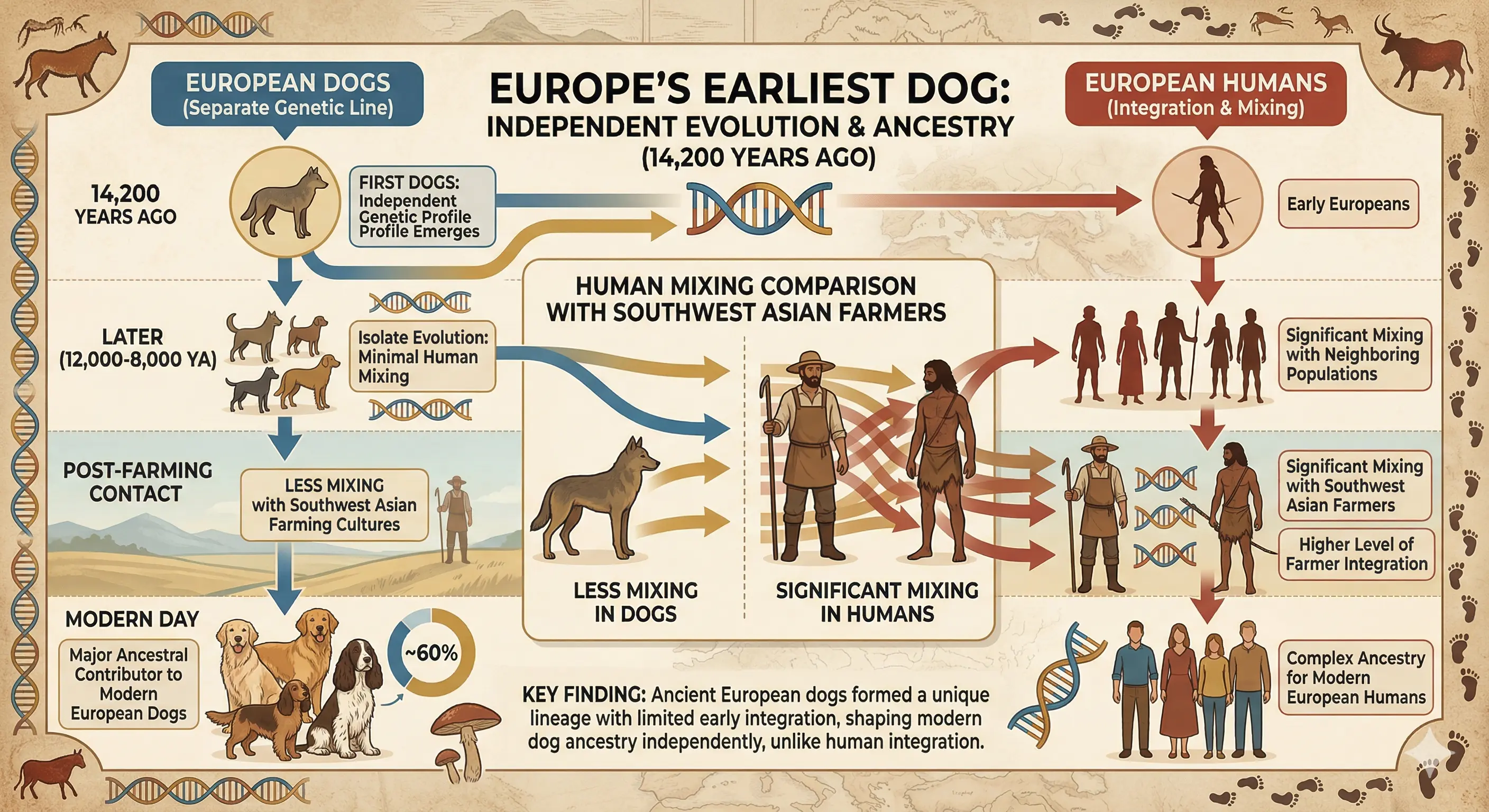
Dogs were already present in Europe at least 14,200 years ago, and even then showed genetic differentiation from dogs in other regions. A study published in Nature confirmed that a dog from the Kesslerloch site in Switzerland shared ancestry with later European dogs. This does not mean that European dogs were domesticated entirely separately from dogs elsewhere.
Remains thought to belong to dogs have been found in Europe dating to about 14,000–17,000 years ago, but in some cases bone morphology alone makes dogs difficult to distinguish from wolves. Genome-wide data on pre-agricultural European dogs were also scarce, leaving unclear how they were related to dogs in other regions and whether their ancestry persisted after the migration of Neolithic farmers.
Key findings: Early differentiation and continuity after farming
The researchers extracted and analyzed DNA from 216 canid specimens. Some specimens may have come from the same individual, so this does not mean that 216 animals were examined. To address the low proportion of the animals’ own DNA preserved in ancient remains, they developed a method to capture selected variants across the genome. In most specimens targeted for capture, the proportion of endogenous DNA increased by 10–100-fold. Dog or wolf genetic ancestry could be identified in 141 of the 216 specimens.
Among these, the 14,200-year-old remains from Kesslerloch were identified as those of a dog. This dog shared ancestry with dogs from other parts of the world, while being genetically closer to later European dogs than to Asian dogs. This provides evidence that regional genetic differentiation among dogs had already begun by 14,200 years ago. That date does not indicate when domestication or differentiation began.
During the Neolithic, ancestry from Southwest Asian dog populations entered European dogs, but the overall extent of this contribution was smaller than the influx of Southwest Asian ancestry in human populations. The estimated proportion of Southwest Asian ancestry in three Neolithic dogs from Scotland was 21–25%. In the early Neolithic European human populations compared in the paper, it was typically at least 70–80%. The estimated proportion in dogs varied by region and period, so the Scottish cases should not be interpreted as a value for Europe as a whole.
Meaning and outlook: Local dog lineages persisted
The results show that, rather than dogs brought by farmers completely replacing existing European dogs, a substantial portion of the ancestry of dogs that lived alongside local hunter-gatherers remained in Neolithic dog populations. The researchers suggest that this genetic legacy may also have persisted in modern European dogs. The extent of its contribution to modern dogs is an estimate, and the same proportion cannot be applied to all breeds.
This study does not resolve where or how many times domestication occurred. Filling the gap in genomic samples from 14,000–10,000 years ago is particularly necessary to trace changes in European dog populations in greater detail. Genetic admixture alone also cannot establish exactly how people kept or exchanged dogs at the time.
Source: The Nature paper “Genomic history of early dogs in Europe,” open full text.
Nature, Published online: 25 March 2026; doi:10.1038/s41586-026-10112-7. Genome-wide analysis reveals that European dogs existed by 14,200 years ago, were already genetically distinct, received less Neolithic Southwest Asian admixture than humans did, and contributed substantially to later European dogs.
In archaeological work, this approach can help researchers assess the bone morphology of suspected dogs alongside genomic analysis and direct dating. The researchers identified wolf ancestry in some remains previously proposed to be dogs on morphological grounds. In other samples from ancient sites, they found evidence suggesting the introduction of later dog remains or contamination by modern dog DNA. This can help reduce errors that arise when dog history is inferred from site dates alone. It also provides grounds for not equating the spread of farmers with the complete replacement of dog populations when comparing the movement histories of humans and dogs. However, continuity of ancestry does not directly establish the purposes for which dogs were kept or the relationships between people and animals at the time.