LNP-based Pulmonary Gene Delivery: Precise Optimization and Safety Assurance for Transplant Immunomodulation
-
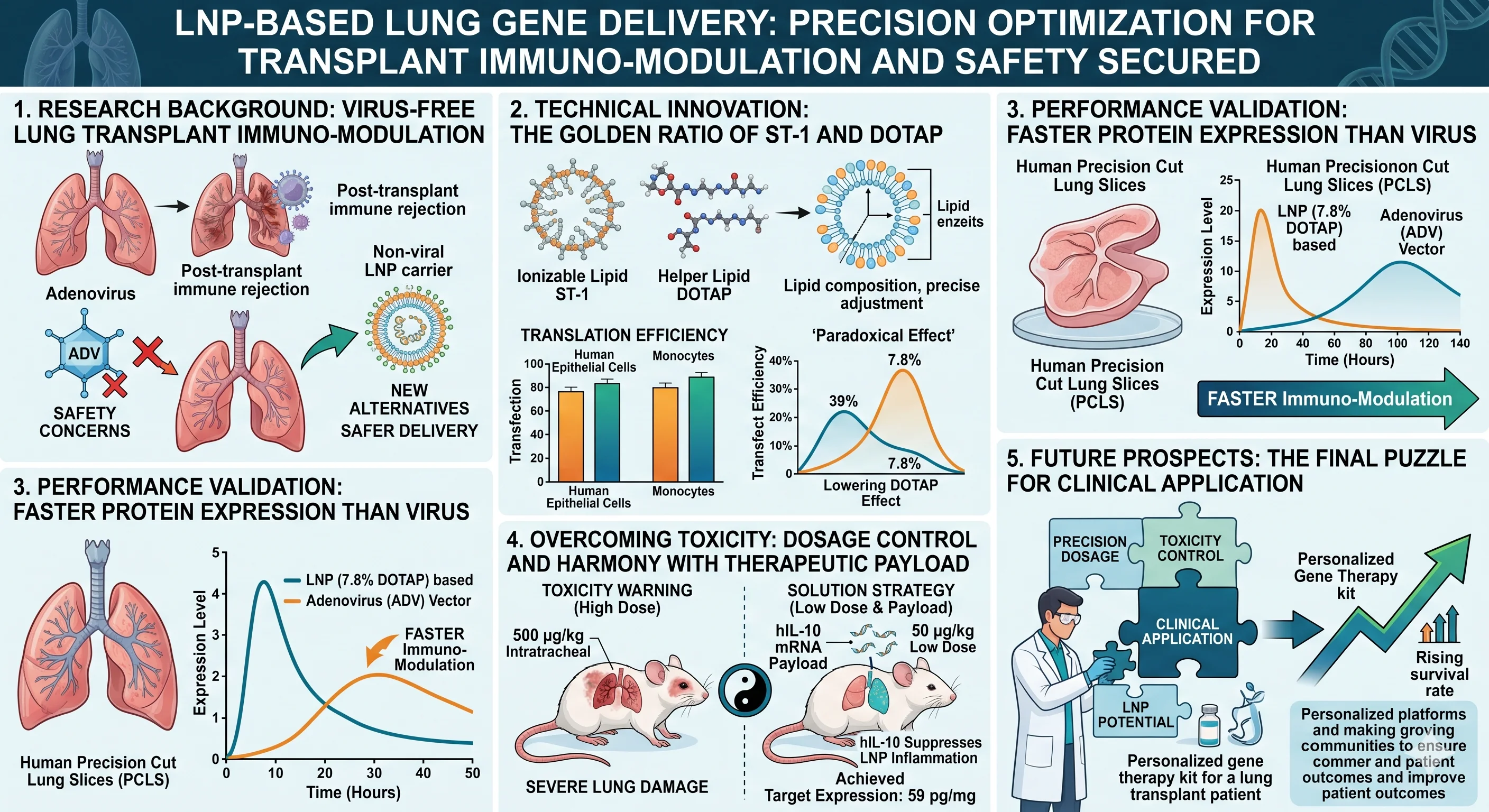
Research background: Non-viral pulmonary transplant immunomodulation Studies delivering genes directly to donor lungs to suppress immune rejection after transplantation are actively pursued. Adenoviral vectors (ADV) have traditionally been used, but safety concerns have prompted the emergence of non-viral carriers such as lipid nanoparticles (LNPs) as a promising alternative.
-
Technical innovation: The optimal ratio of ST-1 and DOTAP The research team focused on ST-1 among various ionizable lipid candidates, precisely adjusting the proportion of the helper lipid DOTAP to maximize delivery efficiency.
- Optimization outcome: Achieved transfection rates exceeding 90% in human lung epithelial cells and monocytes.
- Ratio nuance: Lowering DOTAP content from 39% to 7.8% paradoxically enhanced transfection efficiency, revealing the optimal formulation.
- Performance validation: Faster protein expression than viral vectors The LNP system demonstrated superior performance in a human precision-cut lung slice (PCLS) model.
- Speed advantage: Optimized ST-1 DOTAP (7.8%)-based LNPs reached peak expression markedly sooner than conventional adenoviral vectors, offering a critical benefit for urgent post‑transplant immunomodulation.
- Toxicity mitigation: Dose modulation and therapeutic payload synergy Potential lung injury from LNP administration was a central safety concern addressed in this study.
- Toxicity warning: Intratracheal delivery of a high dose (500 µg/kg) in a mouse model caused severe lung damage.
- Mitigation strategy: Co‑administration of a low dose (50 µg/kg) of anti‑inflammatory cytokine hIL‑10 mRNA suppressed LNP‑induced inflammation while achieving the target protein level (59 pg/mg).
- Outlook: The final piece for clinical translation The study demonstrates that LNPs possess strong potential to replace viral vectors, while emphasizing that precise dose setting and toxicity control are essential before clinical use. Development toward a personalized gene‑therapy platform to improve survival of lung‑transplant recipients is anticipated.
OBJECTIVE: To evaluate the efficiency and protein expression profiles of newly synthesized lipid nanoparticles (LNPs) as a nonviral vector gene delivery platform for gene editing of donor lungs for immunomodulation. METHODS: mCherry mRNA was formulated with 10 LNP candidates (5 ionizable lipids × 2 helper lipids), and gene delivery efficiency in cell lines was assessed using flow cytometry. The most promising LNP was optimized, and its protein expression was compared with that of adenoviral vectors (ADVs) using an mCherry enzyme-linked immunosorbent assay ELISA in a human precision-cut lung slice (PCLS) model. Additionally, intratracheal administration in a rat in vivo model was used to evaluate the relationship between LNP dose and protein expression using mCherry and human interleukin-10 (hIL-10) mRNA. RESULTS: An ionizable lipid ST-1 (formulated with 1,2-dioleoyl-3-trimethylammonium-propane [DOTAP]) achieved high transfection rates of 91.3 ± 6.9% in human lung epithelial cells and 88.4 ± 6.3% in human monocytic cells. Reducing the DOTAP content from 39% to 7.8% further improved the transfection rate. Peak mCherry expression in human PCLS with ST-1 DOTAP (7.8%) occurred at 2 days postadministration, which was faster than with adenoviral vectors. Intratracheal administration of 500 μg/kg of ST-1 DOTAP (7.8%) with mCherry to rat left lungs caused significant lung injury; however, 50 μg/kg of hIL-10 mRNA mitigated the LNP-induced lung inflammation, achieving the target concentration of 59 pg/mg protein in the left lung. CONCLUSIONS: LNPs achieved rapid and efficient protein expression in vitro and in vivo that exceeded the performance of viral vectors; however, significant lung injury was observed with intratracheal LNP administration. This findings underscores the need to further optimize LNP-mediated gene delivery to the lung before translation to the clinic.
Non‑viral LNPs avoid the immune responses associated with conventional viral vectors while enabling efficient gene delivery. This opens a new pathway for safely implementing immunomodulatory therapy after lung transplantation.