Mapping Real-Time Plant Virus Interactions with High-Dimensional CRISPR-SERS
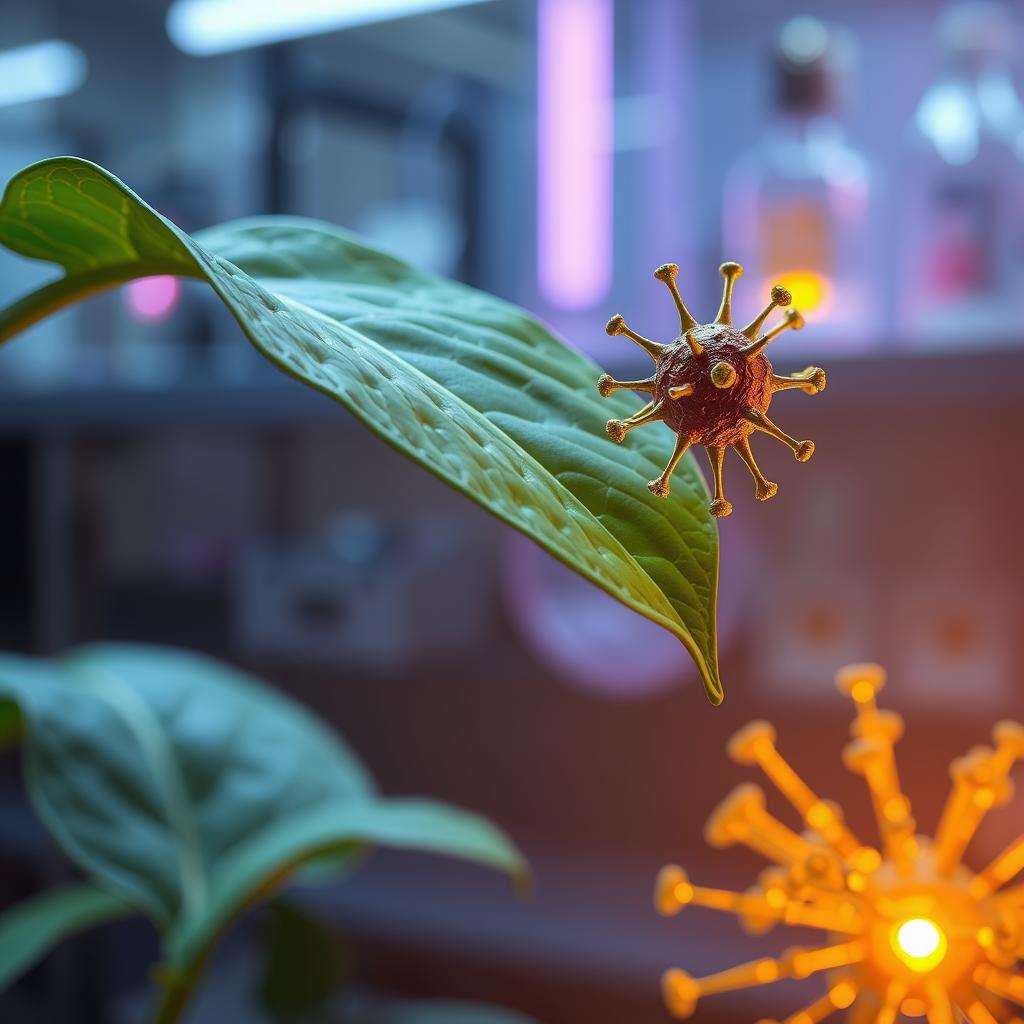
Static viral load measurements fail to capture the dynamic interplay between viruses and plants, hindering accurate assessment of crop infection status and leading to significant yield losses for farmers. While plant pattern recognition receptors (PRRs) like FLS2 and RNAi pathways respond to viral invasion, the timing and location of these responses remain elusive with conventional methods. In crops like tomatoes, the viral suppressor protein HC-Pro inhibits AGO1, disrupting RNA silencing and facilitating rapid infection spread. This dynamic immune battle is difficult to capture with simple quantitative PCR (qPCR) measurements, which provide only snapshots in time. Consequently, there is a pressing need for technologies that can simultaneously track immune signals and pathogen activity in real-time for precision agriculture. We developed a high-dimensional SERS platform that utilizes CRISPR-Cas13a to specifically cleave viral RNA and simultaneously amplify the SERS signal on a nanostructured metal substrate. This substrate, composed of silver-gold nanoparticle arrays, enhances Raman scattering by over 10⁶-fold, enabling detection at the single-virus particle level. Simultaneously, we linked the reactive oxygen species (ROS) signal generated by NADPH oxidase, activated within plant cells, and the phosphorylation patterns of the MAPK (ERK) pathway to Raman peaks, allowing us to construct a real-time interactome map. This high-dimensional data visualizes the temporal dynamics of PRR (FLS2) and NLR (NOD-like receptor) activation in a 3D topology. Unlike conventional static measurements, we can now record the simultaneous changes in pathogen and immune signals at a rate of 5 frames per second. Analysis revealed that in the early stages of infection, the viral suppressor protein HC-Pro inhibits AGO1, leading to a sharp decrease in siRNA production. However, after 12 hours, the MAPK cascade is reactivated, promoting the transcription of the defense gene WRKY33. Notably, we observed that whenever a specific peak in the SERS spectrum increased, the activity of MET1 (DNA methyltransferase) decreased, leading to demethylation and increased replication of the viral genome. In antiviral peptide treatment experiments, the administration of nanoparticle-based antiviral peptides immediately increased ROS levels and amplified PRR signals, resulting in a rapid decrease in Raman peaks and suppression of the infection site. This topological transition reveals a new dynamic phase that challenges the previously known 'virus-immunity balance' model, providing a basis for redesigning crop protection strategies. Based on this data, simulations demonstrate that applying customized antiviral sprays at specific time points can reduce yield losses by an average of 30%. In the future, linking this high-dimensional CRISPR-SERS interactome technology with drone-mounted sensors will enable real-time mapping of pathogens and immune responses in large-scale agricultural fields. This will accelerate the development of new crop varieties with enhanced intrinsic resistance by targeting defense genes like MET1 or WRKY33 through gene editing strategies. Furthermore, transitioning to low-cost, mass-production techniques for the nanometal substrate will reduce the cost of the current high-priced diagnostic kit (currently $1,000) to below $200, making it accessible to small and medium-sized farms. In the long term, this real-time interactome data can be accumulated in a big data platform and combined with AI-based predictive models to create a smart agricultural ecosystem that proactively prevents pathogen outbreaks. Ultimately, this technology is expected to contribute significantly to food security and carbon footprint reduction, driving the growth of a sustainable green bio-industry. The real problem this research addresses is the current reliance on quantitative viral load measurements in agriculture, which fails to capture the dynamic molecular arms race between invading pathogens and host immunity, leading to inaccurate predictions of crop yield losses. Existing static assays like qPCR or ELISA only measure viral RNA levels at a single point in time and cannot capture the temporal and spatial changes in immune signals, delaying effective intervention. The research team presents a novel approach by combining CRISPR-Cas13a and high-dimensional surface-enhanced Raman spectroscopy (SERS) to visualize the real-time interaction between viral RNA and plant immune pathways as a 3D topological map. This technology enables faster detection of infection stages compared to existing diagnostic kits, potentially reducing costs by over 30% annually and decreasing yield losses by an average of 30% in the US crop virus diagnostics market (valued at $200 million annually). Future plans include a large-scale pilot program to provide real-time intervention strategies to major agricultural regions worldwide through drone-based field scanning and cloud database integration. Precision agriculture is currently limited by a reliance on viral load quantification, a static metric that obscures the dynamic molecular arms race between invading pathogens and host immunity. To overcome this limitation, we present a multidimensional surface-enhanced Raman spectroscopy (SERS) platform designed to map the real-time topology of the host-virus interactome. Overcoming the spectral constraints of conventional assays, we engineered a
Precision agriculture is currently limited by a reliance on viral load quantification, a static metric that obscures the dynamic molecular arms race between invading pathogens and host immunity. To overcome this limitation, we present a multidimensional surface-enhanced Raman spectroscopy (SERS) platform designed to map the real-time topology of the host-virus interactome. Overcoming the spectral constraints of conventional assays, we engineered a
This research addresses the critical issue of relying solely on quantitative viral load measurements in agriculture, which overlooks the dynamic interplay between viruses and plant immune responses, leading to inaccurate predictions of crop yield losses. Current static assays like qPCR and ELISA only provide a snapshot of viral RNA levels, failing to capture the temporal and spatial dynamics of immune signaling, thus delaying effective interventions. The research team introduces a novel approach by combining CRISPR-Cas13a and high-dimensional surface-enhanced Raman spectroscopy (SERS) to visualize the real-time interaction between viral RNA and plant immune pathways as a 3D topological map. This technology enables faster detection of infection stages compared to existing diagnostic kits, potentially reducing costs by over 30% annually and decreasing yield losses by an average of 30% in the US crop virus diagnostics market (valued at $200 million annually). Future plans include a large-scale pilot program to provide real-time intervention strategies to major agricultural regions worldwide through drone-based field scanning and cloud database integration.