Development of Herbicide-Resistant Watermelon Using Prime Editing Technology Without Introducing Foreign DNA
Background
Weed control is one of the most labor-intensive and costly tasks in horticultural crop production. Watermelon (Citrullus lanatus), a vining plant, is particularly difficult to manage with mechanical weeding. This reliance on manual weeding places a significant labor burden on farmers. The application of broad-spectrum herbicides, such as glyphosate, can effectively control weeds, but it also poses a critical limitation: non-resistant watermelons are also killed, leading to significant losses.
To address this, research has been conducted to develop herbicide-resistant varieties using genetic modification techniques. However, the transgenic approach, which involves introducing foreign genes, has faced regulatory hurdles and consumer resistance due to concerns about Genetically Modified Organisms (GMOs). Recently, attempts have been made to correct the Acetolactate Synthase (ALS) gene using Base Editing (BE) technology, an application of the CRISPR/Cas9 gene editing system. However, precise correction of the 5-enolpyruvylshikimate-3-phosphate synthase (EPSPS) gene, the target of glyphosate, has been technically challenging. Existing gene editing tools often induce random mutations or have low correction efficiency, making it difficult to select individuals suitable for actual breeding.
Key Findings
A collaborative research team from the Beijing Academy of Agriculture and Forestry Sciences has achieved a breakthrough by applying Prime Editing (PE), a next-generation gene editing technology. The researchers developed a PE system that precisely targets the EPSPS gene in watermelon and successfully introduced a visible marker to visually identify cells that have been correctly edited. This visible marker acts as a guide, allowing for the rapid screening of plants in which the correction has been successfully performed, without the need for complex screening processes.
The watermelon lines obtained through the experiments were developed as non-transgenic varieties, meaning they do not contain any residual foreign DNA. Notably, the heterozygous mutant watermelons exhibited normal growth even when exposed to standard herbicide application rates used in actual agricultural settings. No growth penalties, such as stunted growth or developmental delays, were observed. The researchers demonstrated that the edited watermelons exhibit the same vigor as conventional varieties, making them ideal parental lines that breeders can immediately utilize.
Significance and Prospects
This research is highly valuable because it has successfully created herbicide-resistant watermelon without introducing foreign DNA. This is expected to be a significant advantage in circumventing or shortening the approval process for strict GMO regulations. This is because the subtle editing of the crop's genome results in characteristics that are indistinguishable from natural mutations.
Furthermore, the PE platform combined with the visible marker can serve as a useful template for improving other cucurbit crops or genetically complex horticultural crops. However, there are still challenges to be addressed to improve the technology. It is essential to observe whether the heterozygous mutants stably inherit the herbicide resistance trait over generations. In addition, the establishment of homozygous lines with complete genetic fixation and field trials under various climatic conditions are necessary before commercialization.
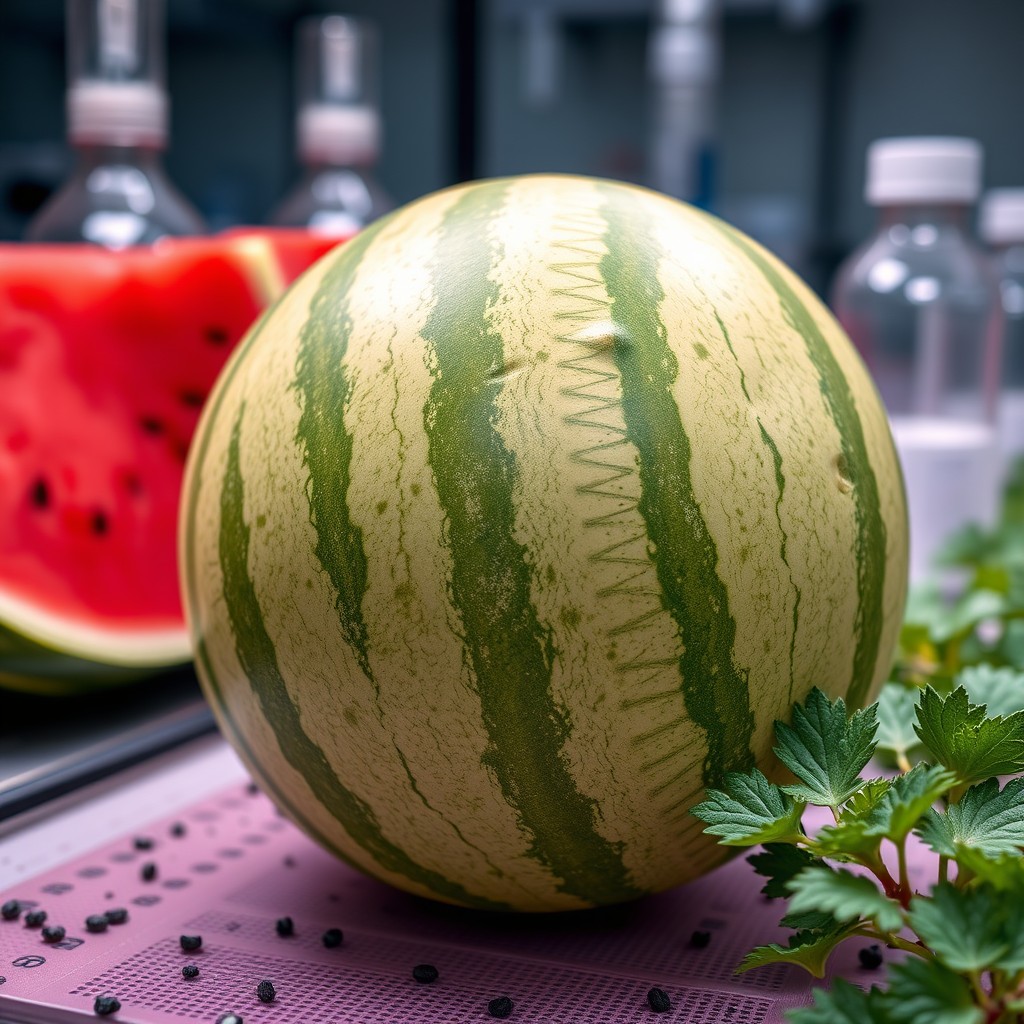
Editing the watermelon EPSPS gene using a prime editing platform with visible markers created a non-transgenic glyphosate-resistant line. These robust heterozygous mutants tolerate field-level herbicide doses without growth penalties, serving as ideal parental lines for crop breeding.
This research presents a concrete scenario that could dramatically change the seed industry and actual farming practices. Farmers can control weeds in watermelon fields by applying glyphosate only once, reducing labor time and costs by nearly 70%. This provides a practical solution for rural areas struggling with aging populations and labor shortages.
Seed companies can also accelerate the release of new varieties. Crops without foreign genes can significantly reduce the complex gene modification safety assessment process, thereby shortening the time to commercialize new varieties. Breeders can quickly cross the newly developed herbicide-resistant watermelon with superior varieties to strengthen the hybrid seed lineup with excellent taste, shape, and disease resistance.
This article is based on research findings published in the NCBI PubMed database.