Comparative toxicity study confirms the potential of Göttingen minipigs to replace rabbits in non-clinical safety assessment of mRNA vaccines
Background
In the field of infectious disease response and anticancer drug development, messenger RNA (mRNA) technology has demonstrated unparalleled speed and scalability. When mRNA vaccines encapsulated in Lipid Nanoparticles (LNP) are injected into the body, they express target antigens within cells, inducing transient systemic immune responses and local inflammation. To confirm the safety margin and detect potential hazards before human administration, non-clinical safety assessment models that precisely mimic human physiology and immune responses must be established beforehand.
In vaccine toxicity testing, rabbits (New Zealand White rabbits) have long been widely used as standard experimental animals. This is because local irritation and fever responses at the intramuscular injection site can be observed rapidly, and there is a wealth of historical data on vaccine evaluation. However, rabbits reveal clear limitations in the precise validation of the mRNA-LNP platform. Their small body size resulted in a grossly insufficient volume of serial blood sampling required for pharmacokinetic analysis or multi-biomarker analysis, and the range of commercially available immuno-inflammatory diagnostic reagents was also limited. Thus, there was a significant physiological gap in tracking subtle hemodynamic changes or complex inflammatory responses from multiple perspectives during repeated dosing.
As an alternative to overcome these constraints, the Göttingen minipig has begun to attract attention. Pigs have a cardiovascular, metabolic, skin, and subcutaneous tissue structure very similar to humans, making them highly useful as non-rodent standard models in general toxicity testing. In particular, compared to small animals, they have a sufficient fluid volume to allow frequent blood sampling, and a wide range of validated inflammatory marker analysis kits is available. Consequently, there was an urgent need for a systematic comparative study to determine whether minipigs could replace existing rabbits in mRNA vaccine evaluation.
Key Findings
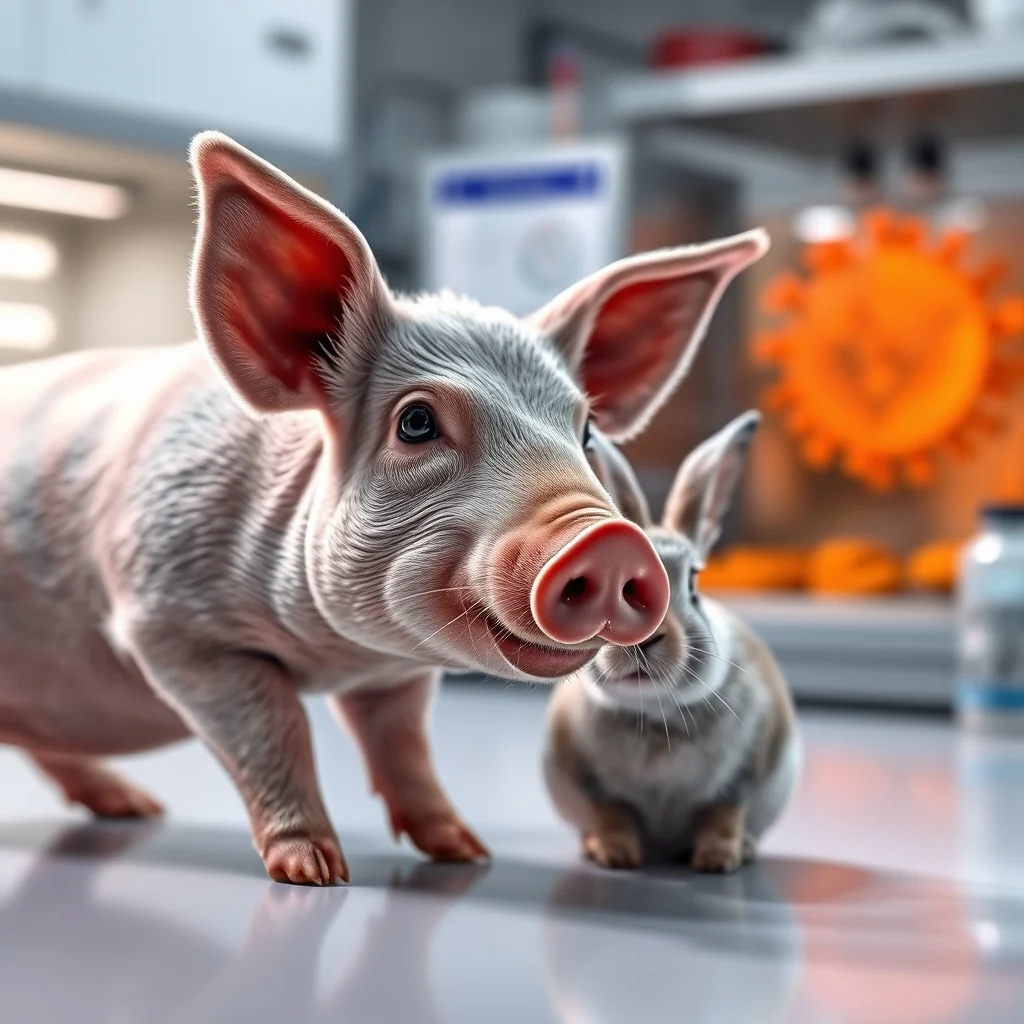
Researchers cross-compared data from two independent toxicity studies where mRNA-LNP vaccine candidates encoding the Hemagglutinin H3 (HA H3) antigen were administered at equivalent dose levels. One study was conducted on rabbits, the existing standard animal, while the other was conducted on the alternative candidate, the Göttingen minipig. Evaluation items comprehensively included general clinical symptom observation, local reactions at the injection site, changes in body weight and feed intake, body temperature measurement, clinical pathology, immunogenicity assessment, inflammatory biomarker measurement, and post-necropsy histopathological examination.
Expected typical immune-inducing responses following mRNA vaccination were observed in both species. Tolerability at the injection site remained at a good level in both, but subtle interspecies differences in local reactivity and fever patterns were identified. Mild, transient induration at the injection site and transient increases in body temperature were observed clearly only in the Göttingen minipig group. This pattern is similar to the post-vaccination low-grade fever or local edema commonly reported in human clinical trials, revealing that minipig models reflect vaccine-induced reactogenicity more sensitively.
Inflammatory response indicators in the blood followed a consistent trajectory in both species. Following vaccination, levels of neutrophils, fibrinogen, and C-reactive protein (CRP) increased transiently and returned to baseline after a certain period. Consistent patterns were also captured in histopathological analysis. The increase in inflammatory cell infiltration at the injection site and the increased germinal center cellularity in the draining lymph nodes were observed at comparable levels between the two species. This means that lymphatic immune activation following mRNA expression and LNP stimulation was identically reproduced in both models.
Implications and Outlook
These results provide preliminary evidence demonstrating that the Göttingen minipig is a valid non-rodent model capable of replacing rabbits in the non-clinical safety assessment of mRNA vaccines. The ability to complete high-density time-series analysis—such as cytokine profiling, complement activation, and in-depth pharmacokinetics—within a single individual based on sufficient blood sampling volume significantly enhances evaluation efficiency. Additionally, the physical advantage of being able to observe local lesions using actual clinical injection needles and devices without modification, thanks to skin thickness and muscle mass similar to humans, is noteworthy.
Challenges to be overcome are also clear. Since this study is based on a post-hoc qualitative comparison of independently conducted tests, direct comparative verification under controlled, identical conditions should follow. Furthermore, because minipigs have higher rearing costs and require larger experimental facilities compared to rabbits, their economic viability in the initial screening stage is somewhat lower. Compared to the historical control database of rabbit-based toxicity data accumulated by regulatory authorities, minipig vaccine data is still in its formative stage. If data applying various antigens and LNP compositions are accumulated in the future, it is expected to establish itself as a core safety assessment platform for next-generation gene therapies and nucleic acid vaccines beyond mRNA.
BACKGROUND: Robust non-clinical safety models are crucial to the development and evaluation of messenger ribonucleic acid (mRNA)-based drugs and vaccines. In this study, we leveraged cross-study data to explore whether the Göttingen minipig could serve as an alternative to the rabbit, a commonly used species in vaccine safety assessment. METHODS: Results from two independent toxicity studies of lipid nanoparticle-encapsulated mRNA encoding the hemagglutinin H3 antigen, administered at equivalent dose levels, were qualitatively compared. Clinical observations, local reactions, body weight, food consumption, body temperature, clinical pathology, immunogenicity, inflammatory biomarkers, and anatomical pathology endpoints were evaluated. RESULTS: Both species exhibited expected vaccine responses, with minor differences in local reactogenicity and body temperature. The vaccine candidate was well tolerated at the injection site in both species. However, mild and transient vaccine-related effects (i.e., injection site induration and increased body temperature) were observed only in minipigs. Transient increases in neutrophil, fibrinogen, and C-reactive protein levels were observed in both species following vaccination, consistent with an inflammatory response. Microscopic findings (i.e., inflammation at the injection site and increased germinal center cellularity in the draining lymph nodes) were comparable between species and aligned with expected immune activation following vaccination. CONCLUSIONS: This qualitative comparison provides preliminary, supportive evidence for the potential use of the minipig as an alternative to the rabbit in non-clinical safety evaluation of mRNA vaccines, with the added benefit of larger blood volume for sampling and availability of validated key inflammatory markers.
This study provides a practical alternative for advancing continuous biomarker sampling and reactogenicity monitoring in the preclinical stage of the mRNA vaccine development pipeline. Drug developers can adhere to animal testing ethics (the 3Rs principles) by consolidating time-series inflammatory analysis—which previously required sacrificing multiple animals due to blood sampling limitations in rabbit models—into a small number of Göttingen minipigs.
For biotechs approaching clinical entry, utilizing validated CRP and multi-cytokine kits in minipigs allows for the prior quantification of risks such as fever and local induration that may arise in Phase 1 human clinical trials, thereby precisely establishing the safety margin for dose selection. In terms of regulatory submission, the ability to secure highly reliable human-like physiological data can significantly reduce uncertainty in the marketing authorization application process.