Behavior of Driver Mutations in Aging Tissues: A Framework Decoupling Clonal Fitness from Carcinogenic Fate
-
Bottleneck in assessing mutant‑clone expansion and cancer‑risk scoring in normal tissue As human bodies age, somatic clones harboring oncogenic driver mutations are frequently observed to expand abnormally within otherwise normal tissues. Conventional molecular‑evolution guidelines have treated the numerical expansion rate or proliferative advantage of mutant clones—often termed “fitness”—as the sole independent variable for linearly estimating long‑term cancer risk. This approach overlooks a functional blind spot: highly proliferative clones do not inevitably progress to malignant tumors, and the covariation noise between fitness and actual carcinogenic “fate” has not been quantitatively controlled. Consequently, precise stratification of high‑risk individuals for preventive diagnostics has remained a persistent technical bottleneck.
-
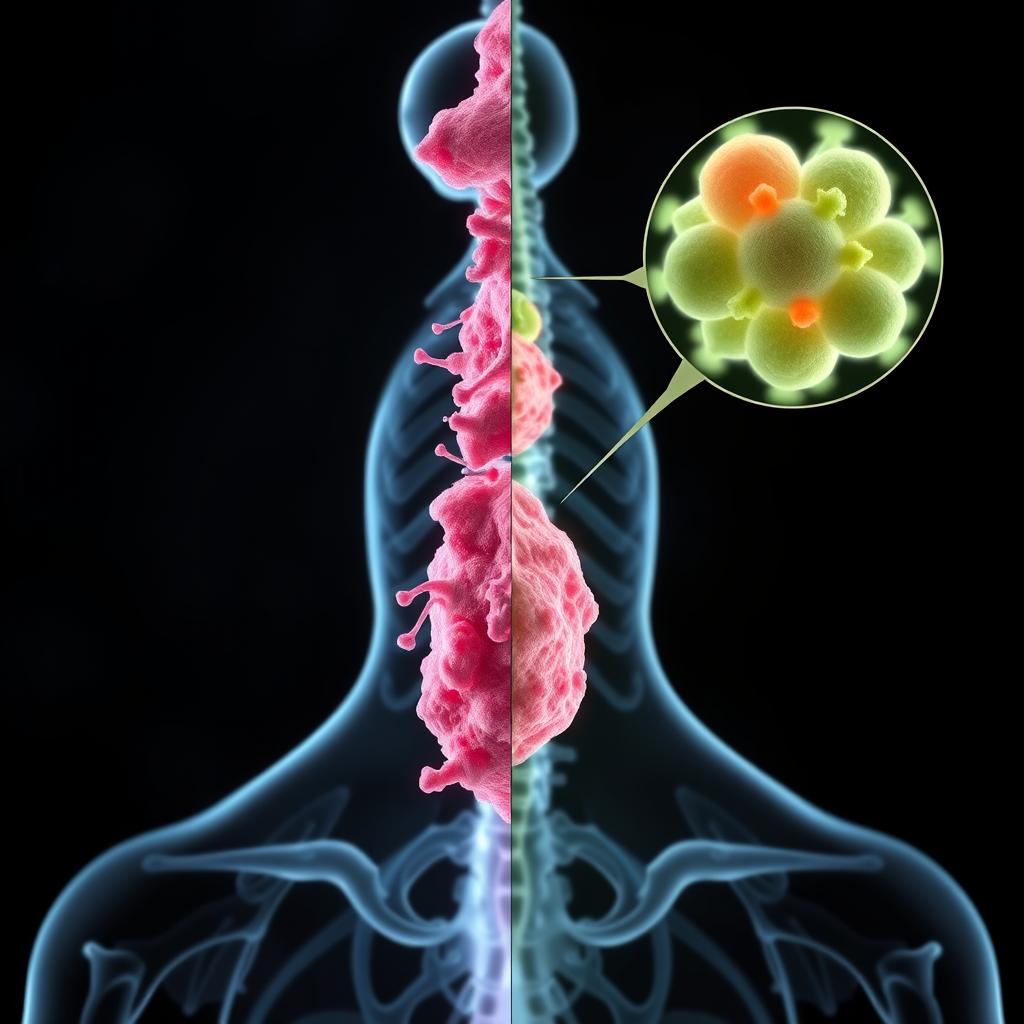
Deployment of the Cheek team’s tensor‑integration analysis: simultaneous computational separation of selective pressure and carcinogenic potential In the study published on 1 June 2026 in Nature Genetics, the authors eliminated this interpretive barrier by integrating a large‑scale ultra‑deep sequencing database of normal tissues with a composite probabilistic model, establishing a full‑scale clone‑success versus carcinogenicity separation framework. By mapping longitudinal genomic fluxes from aged cohorts onto an in‑silico space, the team quantified the selective‑pressure magnitude imposed by specific driver mutations within the normal microenvironment. They demonstrated mathematically that the population‑genetic expansion success (fitness) of mutant clones is uncoupled from the malignant‑cell transition stage (carcinogenic fate), thereby proving the molecular‑evolutionary integrity of the system.
-
Re‑evaluation of the true oncogenic penetrance of driver mutations and filtering of false‑positive risk Omics‑centric epidemiological tracking revealed that the actual risk contribution of several driver‑mutation groups—previously regarded as unconditional cancer‑inducing factors in standard diagnostics—must be reassessed at high resolution.
- Fitness‑Fate Decoupling: Even frequently observed expanding clones in normal aging tissues can be constrained by local tissue architecture and epigenetic‑repressive tensors, producing a quantifiable causal matrix that limits oncogenic fate.
- Elimination of false‑positive prognostic noise: By dramatically improving upon existing polygenic risk score (PRS) models that misclassify benign expanding clones as malignant precursors, the specificity of clinical screening was substantially corrected.
- Establishment of a programmable aging‑clock standard and activation of a next‑generation cancer‑prevention governance backbone The integrated somatic‑evolution and tumor‑statistics data compendium redefines early‑cancer‑diagnosis standards from a static mutation‑detection paradigm to a “programmable cancer‑prediction infrastructure” that simultaneously computes clonal cellular‑dynamics weights and microenvironmental transition probabilities. Multinational pharmaceutical firms and liquid‑biopsy diagnostic companies have incorporated computational correction coefficients that nullify unnecessary false‑positive therapeutic interventions in their premium early‑detection R&D pipelines. The derived fitness‑fate separation constant will serve as a computational backbone for reverse‑engineering clonal hematopoiesis of indeterminate potential (CHIP) and tissue‑failure prognostics in other chronic aging diseases, dramatically shortening global IND approval timelines for next‑generation preventive‑medicine platforms.
Nature Genetics, Published online: 01 June 2026. DOI: 10.1038/s41588-026-02631-w
Summary: Resolving the diagnostic overestimations and loose correlation metrics that often miscalculate early oncogenic risk by conflating somatic expansion rates with clinical malignancy, this paper constructs a clonal trajectory evaluation framework. Analyzing high-throughput whole-genome sequencing datasets across aging human cohorts, the platform successfully uncouples mutation-driven fitness advantages from actual carcinogenic fate pathways. The unified computational model demonstrates that widespread driver mutation variants expanding programmatically within aging tissues often exhibit heavily restricted oncogenic penetrance due to local tissue microenvironment boundaries. This calibration offers a precise, generalizable computational baseline to filter false-positive screening signals, optimize universal patient stratification, and guide future target prevention clinical decisions.
The evolutionary‑genomics discoveries reported in this study extend beyond theoretical methodology to directly power liquid‑biopsy‑based early‑cancer‑diagnosis supply chains and digital precision‑medicine business lines. First, by instantly scanning the terminal destinations of driver‑mutation clones expanding within epithelial and hematopoietic compartments of aged patients using Python algorithms, chronic over‑diagnosis noise in pre‑malignant stages is eliminated at the source, preserving a reversible health‑span extension margin. Simultaneously, linking aggregated clonal‑fitness metrics to open‑source, large‑scale genome‑database matrices enables virtual simulation of false‑positive genetic and environmental confounders during clinical‑trial design, and real‑time back‑calculation of effective intracellular toxic concentrations for candidate cancer‑preventive agents via a companion‑diagnostic panel interface. Moreover, when multinational pharma companies advance large‑scale approval trials for next‑generation anticancer drugs and geroprotectors, integrating genome‑landscape‑specific mutation‑penetrance correction factors across participant cohorts neutralizes inter‑subject pharmacokinetic variability, thereby maximizing regulatory approval probabilities and functioning as a backbone infrastructure for global regulatory submissions.