Autism genetics study in people of Latin American ancestry finds substantial gene overlap with European-focused research
Autism genetics research has focused largely on people of European ancestry
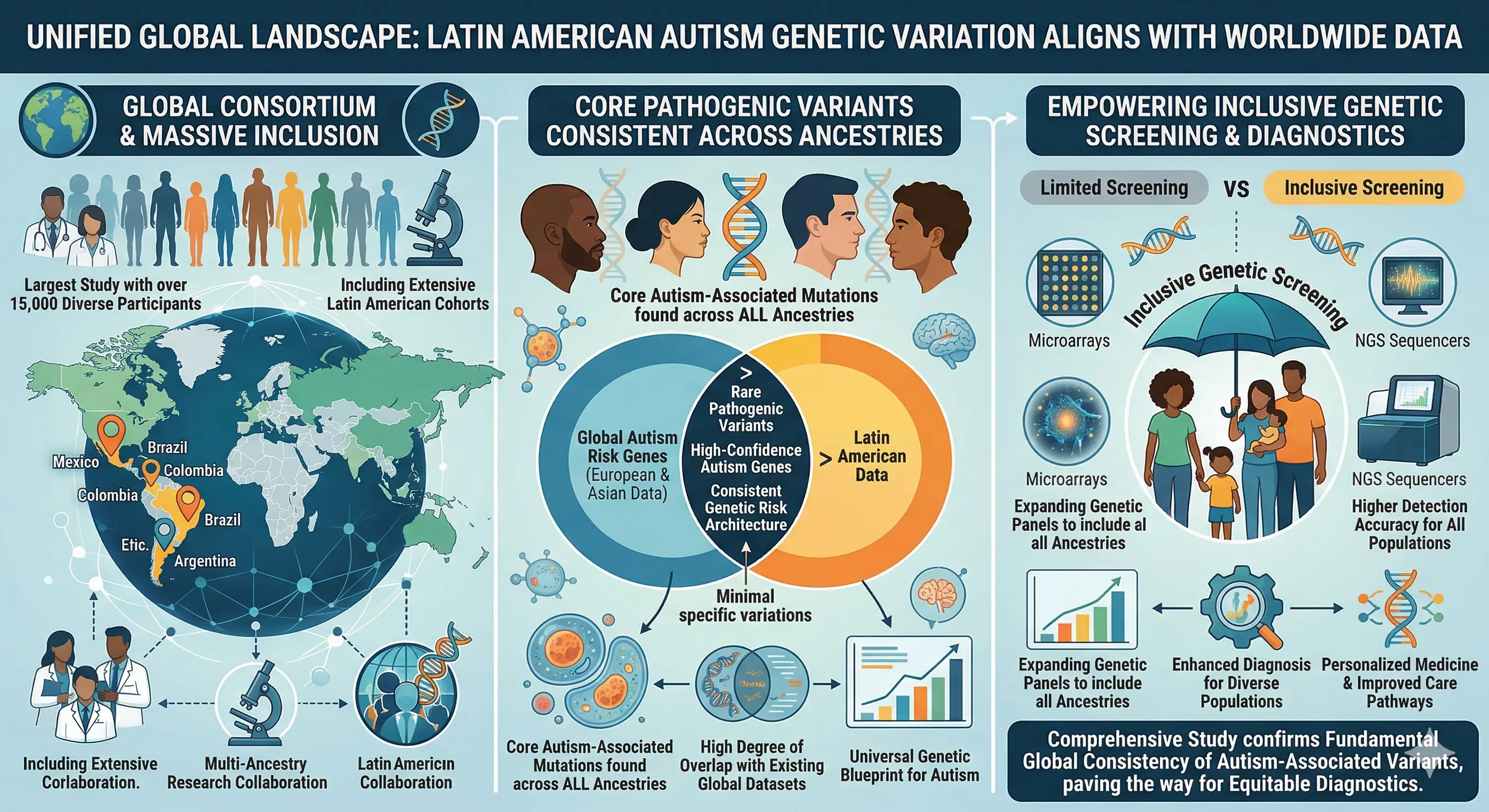
A study analyzing genetic data from 15,427 people, including participants of Latin American ancestry and their families, identified 35 autism-associated genes. Nineteen of these also showed significant associations in a separate comparison dataset composed mainly of people of European ancestry. The findings indicate cross-ancestry overlap among genes affected by rare, damaging coding variants associated with autism. They do not mean that genetic variation is identical across populations.
Earlier autism gene-discovery studies focused on participants of European ancestry, leaving limited data to assess whether their findings apply to people with other genetic backgrounds. The GALA Consortium analyzed samples from people of Latin American ancestry across the Americas to help address this gap. The study was published in Nature Medicine.
Thirty-five associated genes and overlap with the comparison group
The full sequencing cohort included 4,717 people diagnosed with autism spectrum disorder (ASD), as well as parents, siblings, and controls. Parents’ data helped identify variants that arose de novo in their children; the variant-burden analysis excluding parents included 6,977 people. The full cohort of 15,427 should therefore not be interpreted as consisting entirely of people diagnosed with autism.
The researchers used the TADA method, which integrates de novo variants not inherited from parents, inherited variants, and case–control data. Thirty-five autism-associated genes met a false discovery rate (FDR) threshold below 0.05, accounting for multiple testing. Not all were newly discovered in this study: the set included previously known genes and genes for which evidence of an association is still accumulating.
To avoid overlap, the researchers removed samples from people of Latin American ancestry from the earlier studies used for comparison. In the resulting non-Latin American ancestry dataset, composed mainly of people of European ancestry, 19 of the 35 genes showed significant signals. The concentration of autism-associated signals in genes in which natural selection keeps function-damaging variants rare was also consistent with earlier research.
Support for genetic test interpretation, with gaps remaining
The findings add support for using existing research when interpreting rare autism-associated variants across diverse genetic backgrounds. They do not, however, eliminate disparities in the interpretation of test results.
When de novo variants in autism-associated genes were classified using the variant-interpretation software VarSome, the proportion of diagnosed participants with at least one variant classified as pathogenic or likely pathogenic was 4.31% among those of Latin American ancestry and 5.53% among those of non-Latin American ancestry. These are classification results from this analysis; they do not represent the accuracy of genetic testing in general or its overall diagnostic yield. The researchers also stated that, because the participants’ full clinical characteristics were not taken into account, these classifications should not be considered assessments that fully meet the American College of Medical Genetics and Genomics (ACMG) variant-classification guidelines.
The exome-centered design also limited precise analysis of the ancestral origin of the genomic segment containing each variant. Limited population-specific variant-frequency data and the possibility of detection errors remain additional challenges. The findings therefore support biological commonalities across populations, but do not demonstrate treatment efficacy or the realization of treatment design.
Source: Original study in Nature Medicine.
Nature Medicine, Published online: March 30, 2026; doi:10.1038/s41591-026-04228-6 Genetic analyses of more than 15,000 individuals across the Americas, including those with autism and their relatives, delineate the genetic profile of autism within Latin American communities and highlight significant genetic overlaps with other ancestries.
The study expands the evidence supporting the use of existing autism gene research when interpreting genetic test results for people of Latin American ancestry with autism and their families. In testing laboratories, assessing how rare a variant is forms an important part of interpretation. Using only the average frequency across the overall population could cause a variant that is relatively common in a particular ancestry group to be mistaken for a rare variant. The researchers therefore recommend also checking variant frequencies in relevant subpopulations. The study points to ways to improve test-interpretation procedures and reference data. Because disparities between populations in pathogenicity classification remain, the clinical significance of an individual variant should be assessed alongside family information and the person’s clinical characteristics.