Muscle Reprogramming After Peripheral Nerve Injury: Promise and Limits of Preclinical Research
Background
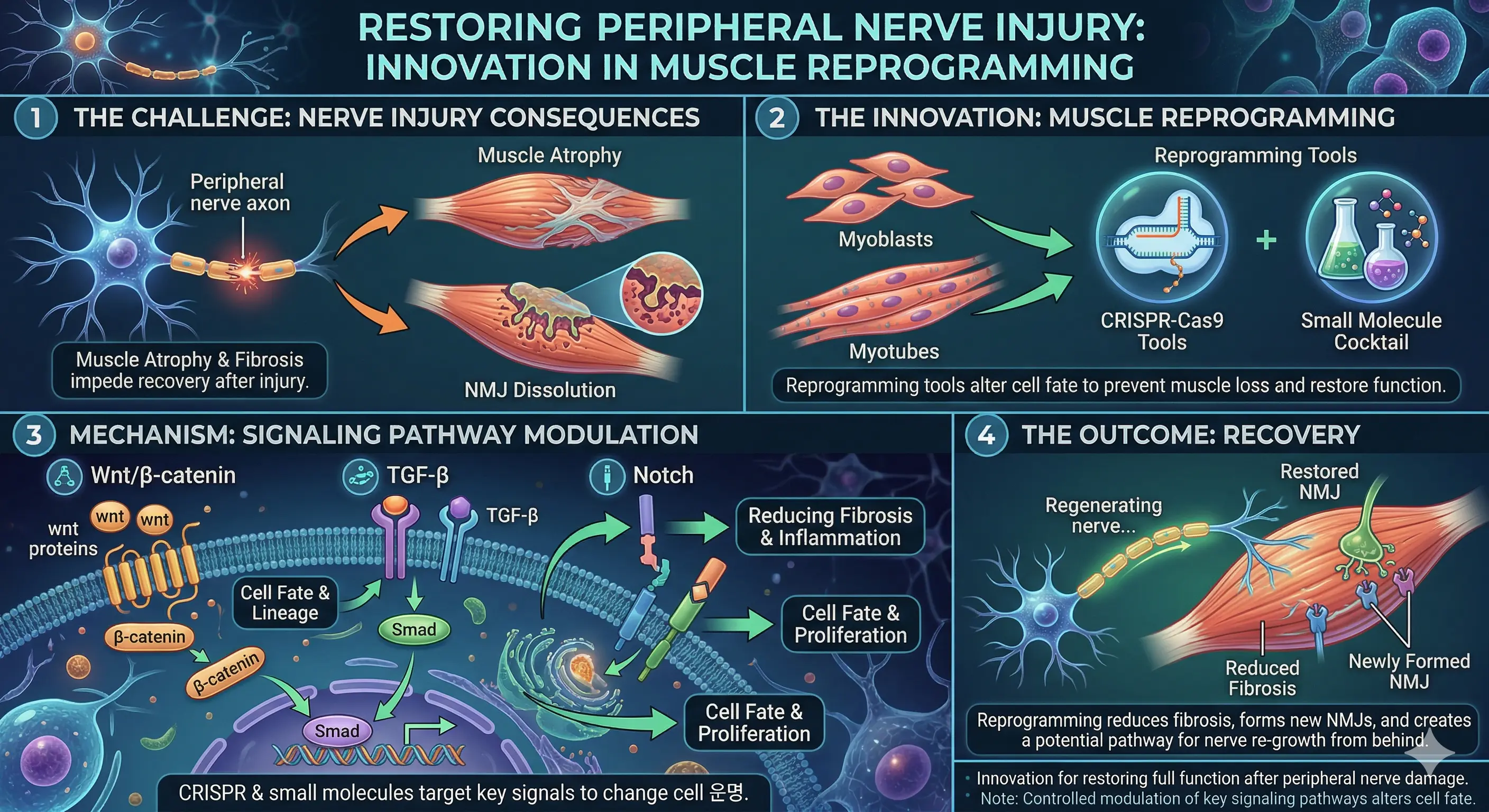
Muscle reprogramming is being studied as an approach to reduce muscle atrophy and fibrosis after peripheral nerve injury and support neuromuscular junction reformation. A review published in Experimental Biology and Medicine summarized the mechanisms, therapeutic potential, and challenges to clinical application. It did not report results from a new clinical trial; efficacy evidence comes mainly from rodent studies.
When reinnervation—the reconnection of injured nerves to muscle—is delayed or incomplete, existing nerve repair strategies alone may provide limited functional recovery. The rationale for targeting muscle is to preserve the condition of the tissue that the regenerating nerve must reconnect with.
Key Findings
The review discusses how muscle reprogramming might mitigate muscle atrophy caused by loss of nerve connections, slow fibrosis, and support reformation of the neuromuscular junction (NMJ), where nerves and muscles communicate. Reprogramming here is not limited to changing the fate of muscle cells. It also includes interventions that modulate the function and metabolic state of cells residing in muscle, as well as their surrounding environment.
Targets include satellite cells, which are responsible for muscle regeneration, and fibro-adipogenic progenitors, which contribute to fibrosis and fat accumulation in chronic injury settings. Modulation of Wnt/β-catenin, transforming growth factor beta (TGF-β), and Notch signaling, along with combinations of small molecules, is presented as a research tool for changing how these cells respond. Because the targets and methods of modulation differ, these approaches should not be treated as a single therapy.
CRISPR-based transcriptional activation (CRISPRa) is also reviewed. It is distinct from approaches that alter DNA sequences by cutting DNA; it activates the expression of genes involved in muscle formation. The review also explains the possibility that retrograde signals from muscle to nerve could support nerve regrowth. These mechanisms and preclinical findings alone, however, cannot establish therapeutic efficacy in people.
Implications and Outlook
Combining muscle preservation and regeneration with nerve repair aims to restore the connection between nerve and muscle. Muscle reprogramming is presented as a research direction that could complement existing nerve repair. The evidence does not support concluding that it has substantially increased patients’ prospects for recovery.
Before application in people, researchers must determine whether intervention agents can be delivered to the intended cells and whether new muscle cells mature sufficiently and establish functional nerve connections. Immune responses, unintended cellular changes, tumorigenicity, and long-term safety also remain unresolved issues. Some specific efficacy claims in the review do not match the topics of their cited references, so numerical results or treatment timing should not be treated as criteria for clinical application without checking the individual original studies.
Source: Full review available through Europe PMC.
Peripheral nerve injury (PNI) presents a significant clinical challenge, frequently leading to long-term neuromuscular dysfunction, muscle atrophy, fibrosis, and chronic pain. Traditional repair strategies, including microsurgical reconnection and neurotrophic support, often yield limited functional recovery, especially in cases of delayed or incomplete reinnervation. In this context, skeletal muscle reprogramming-defined as the intentional modulation of cellular fate, function, or metabolic state in muscle-resident cells-has emerged as a promising strategy to enhance regenerative outcomes. This process involves transcriptional, epigenetic, and metabolic interventions targeting myogenic progenitors, fibro-adipogenic progenitors (FAPs), satellite cells (MuSCs), and the broader muscle microenvironment. Recent studies demonstrate that reprogramming strategies can mitigate denervation-induced muscle atrophy, delay fibrotic remodeling, promote neuromuscular junction (NMJ) reconstruction, and even stimulate endogenous nerve regrowth via retrograde signaling. Mechanistic insights have uncovered pivotal roles for signaling pathways such as Wnt/β-catenin, TGF-β, Notch, and HDAC-regulated chromatin dynamics. Furthermore, innovations in small molecule cocktails, CRISPR-based transcriptional reactivation, and metabolic rewiring have expanded the therapeutic toolkit for muscle preservation and regeneration. This review comprehensively examines the molecular mechanisms, therapeutic roles, and translational challenges of skeletal muscle reprogramming in the context of PNI. We explore how muscle-targeted interventions can address complications of denervation, improve the efficacy of nerve repair, and offer a synergistic axis of regeneration when integrated with nerve-centric strategies. Finally, we identify key knowledge gaps and outline future research directions required to translate reprogramming-based therapies into clinical practice.
If muscle atrophy and fibrosis could be reduced while waiting for reinnervation after nerve repair surgery, this might help preserve the condition of the muscle to which the regenerated nerve will connect. One concrete follow-up research scenario would combine nerve repair with a local muscle-targeted intervention and assess not only muscle mass but also neuromuscular junction function and motor recovery. This is a research direction proposed by the review. It cannot be interpreted as a treatment with demonstrated efficacy in patients. Before application, delivery efficiency, target specificity, long-term safety, and actual functional improvement must be verified.