MPS proposed as a complementary tool for evaluating AAV gene therapy candidates
Background
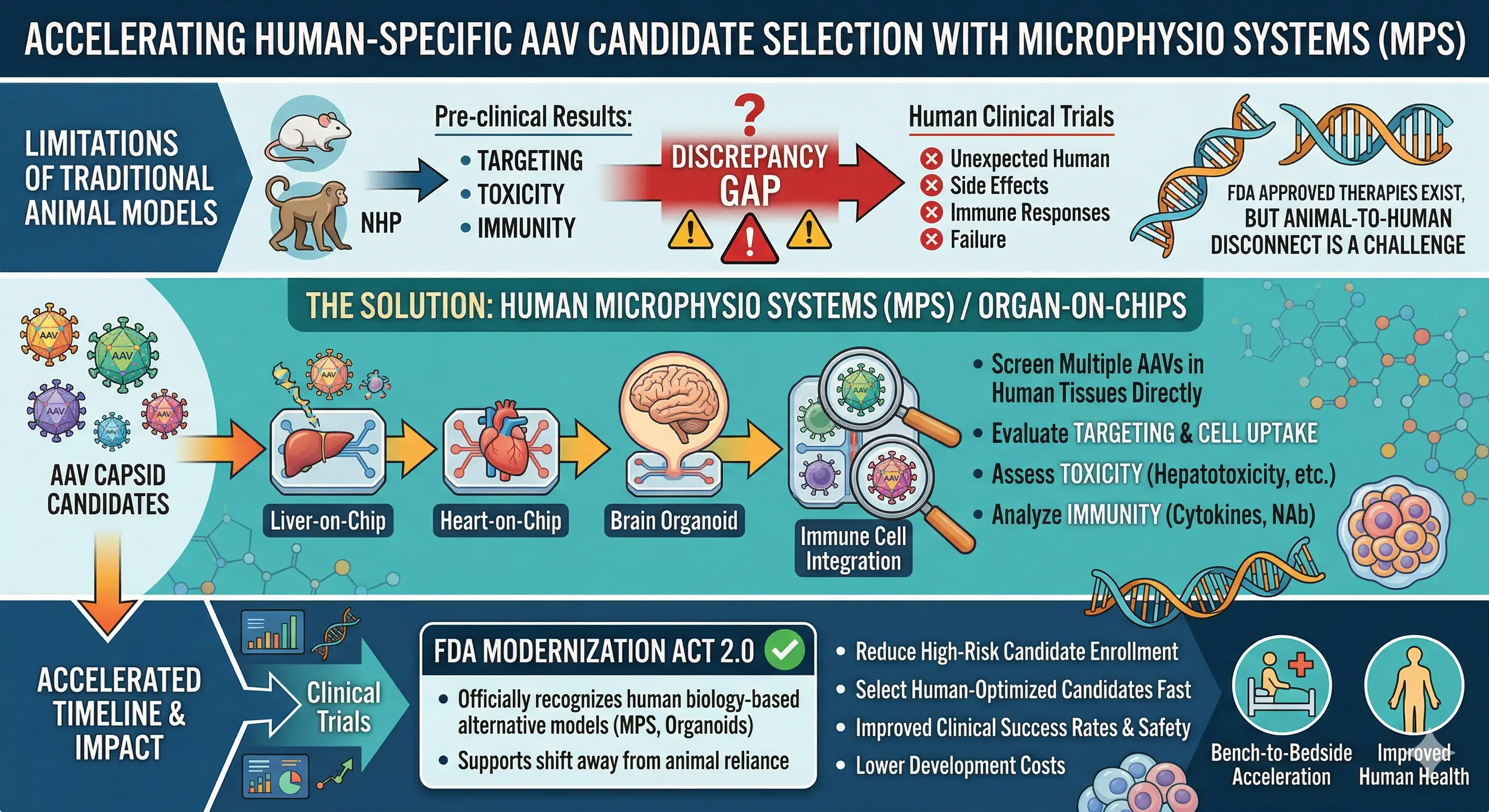
A review proposes using microphysiological systems (MPS) as complementary tools to narrow the gap between preclinical predictions and clinical outcomes in adeno-associated virus (AAV) gene therapy. The authors mention eight AAV-based products with regulatory approval across several disease areas, while noting that predicting clinical outcomes still has limitations. Key challenges include hepatotoxicity, immune responses, and tissue tropism—factors that may differ between preclinical assessments and actual patients.
Key findings
The review presents MPS, including organoids and organ-on-a-chip systems, as an approach for assessing AAV tissue tropism, safety, and efficacy in environments that reflect human tissue characteristics. Tissue tropism refers to which tissues a vector targets. The authors summarize research trends and current limitations in applying MPS to AAV evaluation and propose a framework for integrating these systems into the development process.
However, the provided abstract does not report the predictive accuracy of any specific MPS, candidate screening speed, or reductions in clinical failure rates. It is important to distinguish this review of existing research and potential applications from an experimental report directly demonstrating performance in selecting new candidates.
Implications and outlook
MPS may serve as a complementary filter for prioritizing candidates with a higher likelihood of clinical success. This does not mean they can reliably eliminate risky candidates or guarantee safety and efficacy in patients. Which models suit which evaluation purposes, and how well they predict actual clinical outcomes, require separate validation.
The abstract describes the FDA Modernization Act 2.0 and the U.S. National Institutes of Health (NIH) Office of Research Innovation, Validation, and Application (ORIVA) as developments promoting the adoption and qualification of human-based models. This description alone does not establish the regulatory acceptance of any particular MPS or the extent to which it can replace animal testing. Details can be found in the abstract of the review published in Advanced Drug Delivery Reviews.
Adeno-associated viral (AAV) vectors dominate gene therapy, boasting eight FDA-approved products across diverse diseases. However, their clinical efficacy remains partially predictable due to mismatches between preclinical predictions and real-world outcomes, notably concerning adverse events including liver toxicity, immune responses, and tissue specificity. Microphysiological systems (MPS), encompassing organoids and chips mimicking organs, present a robust solution by offering human-relevant contexts for evaluating AAV vectors regarding tropism, safety, and efficacy. This methodology aligns with emerging methodologies recognized by regulatory bodies such as the FDA Modernization Act 2.0 and NIH's ORIVA, fostering the integration of human-based models in biomedical research. This review encapsulates recent advancements in MPS application for AAV assessment, delineates existing limitations, and proposes a strategic framework for MPS integration into AAV development pipelines. Ultimately, MPS functions as a critical "human-relevant filter" to prioritize vectors most likely to succeed clinically, ensuring only the safest and most efficacious candidates proceed to patient trials.
When deciding the order in which to evaluate multiple candidate vectors, AAV developers could consider MPS results that reflect human tissue characteristics as complementary evidence. The idea is to review information on tissue tropism, safety, and efficacy alongside existing preclinical data to narrow the candidates for follow-up validation. However, this review abstract alone cannot establish criteria for excluding candidates or determine clinical predictive performance. Reducing clinical failure risk and accelerating development are anticipated benefits; practical use requires validation of each model’s performance and suitability for the intended evaluation purpose.