In vivo BCMA CAR-T: 4 of 5 myeloma patients responded in a phase 1 trial; all experienced grade 3 or higher adverse events
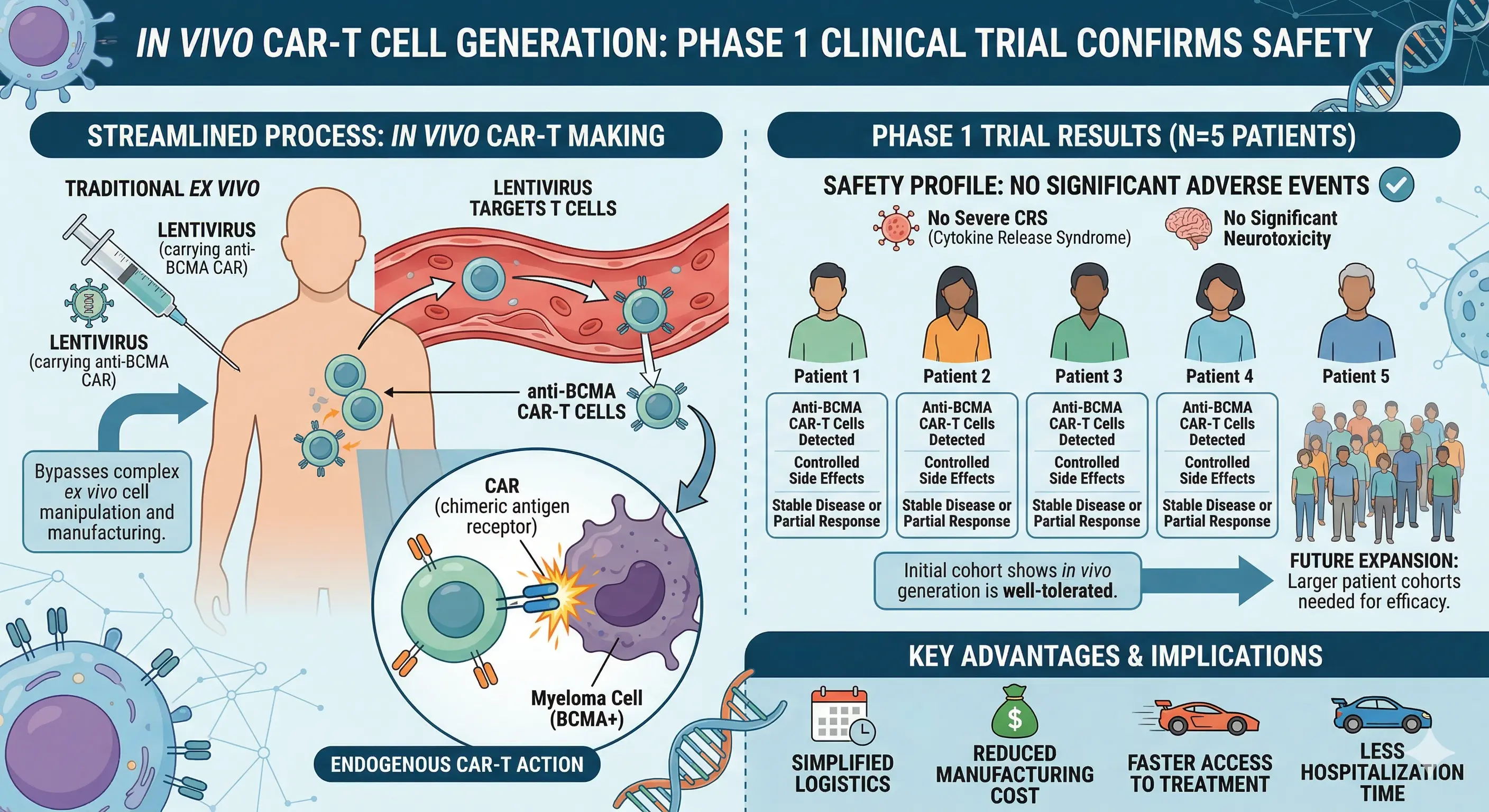
Early responses without ex vivo manufacturing
An approach that generates anti-BCMA CAR-T cells inside the patient showed feasibility and preliminary antimyeloma activity in a phase 1 trial involving five patients with relapsed or refractory multiple myeloma. Four had an objective response, but all five experienced grade 3 or higher adverse events. No dose-limiting toxicities occurred; this should not be interpreted as establishing safety without serious adverse effects. The study was formally published in Nature Medicine on March 25, 2026.
Rather than infusing finished CAR-T cells, the trial administered ESO-T01, a lentiviral vector carrying genetic information for a chimeric antigen receptor (CAR) that recognizes BCMA (B-cell maturation antigen). The approach generates CAR-T cells in vivo without leukapheresis, ex vivo cell manufacturing, or lymphodepleting chemotherapy.
A T-cell-targeting vector and trial design
ESO-T01 uses a nanobody directed at the TCR/CD3 complex and a T-cell-specific promoter. The vector is designed to target T cells and restrict CAR expression to T cells. According to the published extended-data descriptions, peripheral blood testing at the time of peak CAR-T-cell expansion found CAR positivity below 1% in every non-T-cell population analyzed. This observation applies to those samples at that time point; it does not rule out off-target delivery in other tissues or over longer periods.
This was an uncontrolled, open-label, single-arm phase 1 study. Five adult men were enrolled consecutively; the median number of prior lines of therapy was three. Each received one intravenous dose of 0.2 × 10⁹ transducing units of ESO-T01, and the median follow-up was 6.0 months. The primary endpoints were safety and tolerability; secondary endpoints included efficacy, pharmacokinetics, and pharmacodynamics. The trial ended early in 2025, with no further enrollment. The provided abstract does not state why it ended.
Antimyeloma activity alongside toxicity
Four of the five patients had an objective response, including three who achieved a stringent complete response. All four evaluable responders were confirmed negative for minimal residual disease (MRD) at a sensitivity of 10⁻⁵ by day 60 after dosing. This means residual disease was not detected within the limits of that assay; it does not demonstrate cure or long-term remission.
No dose-limiting toxicities were observed, but every patient experienced grade 3 or higher adverse events. Cytokine release syndrome (CRS) occurred in four patients: three cases were grade 3 and one was grade 2. CRS was managed with corticosteroids, tocilizumab, or supportive care. Frequent toxicities included transient cytopenias and reversible elevations in liver enzymes; three patients had grade 2 infections.
One patient experienced grade 1 immune effector cell-associated neurotoxicity and later died. The abstract describes the cause of death as spinal cord compression associated with an extramedullary lesion. The extended-data descriptions report that the patient died 19 days after dosing and did not achieve sustained clinical remission. The fact that neurotoxicity and death occurred in the same patient does not by itself establish neurotoxicity as the cause of death.
Potentially simpler manufacturing, but further validation is needed
The investigators interpreted the findings as preliminary evidence for the feasibility and safety of in vivo CAR-T-cell generation using an immune-shielded vector. However, the study included only five patients, all of them men; it had no control group, and follow-up was limited. It did not establish whether the approach is safer or more effective than conventional CAR-T therapy, how long responses last, or whether access to treatment improves in practice. The potential to omit cell-manufacturing steps must be assessed alongside the clinical burden of managing the observed toxicities.
The study design and findings are available in the public abstract and extended-data descriptions of the original Nature Medicine paper.
Nature Medicine, Published online: 25 March 2026; doi:10.1038/s41591-026-04244-6In a phase 1 trial, the in vivo generation of anti-BCMA CAR-T cells by lentiviral delivery was feasible and did not lead to dose-limiting toxicities in five patients with relapsed or refractory multiple myeloma.
This study is significant because it observed early antimyeloma responses using an approach that generates CAR-T cells inside the patient rather than manufacturing them ex vivo. Evaluating a clinical pathway that omits leukapheresis, ex vivo manufacturing, and lymphodepleting chemotherapy in actual patients provides a starting point for further development. However, fewer manufacturing steps do not establish a reduction in treatment burden or cost, or improved access. Because every patient experienced grade 3 or higher adverse events, the resources needed to manage toxicity also require evaluation. More diverse patient populations and sufficient follow-up are needed to assess response durability, long-term safety, the specificity of in vivo delivery, and benefits relative to existing treatments.