Development of a Novel CRISPR Suicide Switch that Targets Mutant RNA in Cancer Cells and Self-Destructs the Genome
Background
Conventional cancer treatments primarily target the three-dimensional structure of proteins that cause cancer. However, when even minor mutations occur in the protein structure, reducing its ability to bind to drugs, cancer cells often easily acquire resistance. To address this, attempts have been made to utilize gene editing technology, CRISPR-Cas9. However, it is technically almost impossible to individually correct the genes of the billions of cancer cells present in a patient's body. Furthermore, the potential for unintended mutations during the gene editing process is also a concern. Therefore, there is a need for a completely new gene editing technology that, instead of gene correction, targets and kills only cancer cells. This is why the academic community has begun to shift its focus from the original function of gene editing, 'gene correction,' to 'selective cell killing.'
Key Findings
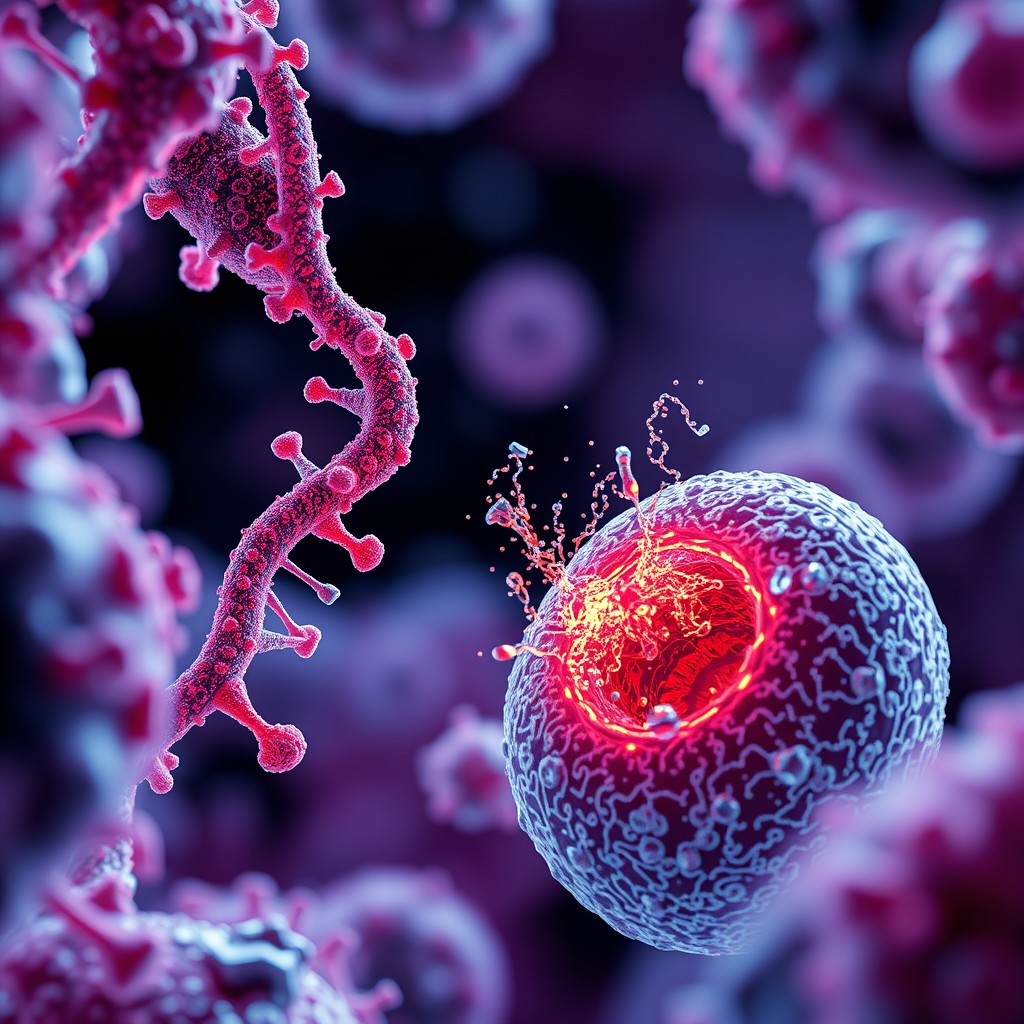
An international research team, including researchers from the University of Utah, the University of Utah School of Medicine, and the Helmholtz Centre for Infection Research (HIRI) in Germany, focused on the unique immune mechanism of the CRISPR-Cas12a2 protein, a gene editing protein. The researchers demonstrated that Cas12a2 undergoes structural changes upon binding to a specific RNA sequence, causing it to indiscriminately cleave all nucleic acids within the cell. While conventional gene editing tools act as 'molecular scissors' that precisely cut specific DNA regions, Cas12a2 functions as a 'genome shredder' that destroys all single-stranded RNA (ssRNA), single-stranded DNA (ssDNA), and double-stranded DNA (dsDNA) in its vicinity as soon as it is activated. This widespread nucleic acid degradation completely disrupts the cell's metabolic function, leading to its self-destruction. In laboratory experiments, the researchers targeted KRAS G12D mutant RNA, which has only a single base mutation. Cas12a2 accurately detected and killed cancer cells containing the mutant RNA, while having no effect on normal cells without the mutation. This is interpreted as a highly precise gene switch technology that determines the survival of cancer cells based on the presence or absence of a specific RNA within the cell.
Significance and Prospects
This research is considered a turning point in the paradigm of gene therapy, shifting it from 'correction' to 'targeted cell killing.' In particular, it is expected to provide a new breakthrough in the treatment of tumors that were previously impossible to target with existing drugs, as it does not rely on the structural defects of target proteins but instead detects abnormal RNA produced by cancer cells. Akribion Therapeutics, a German biotechnology company, is developing a therapeutic agent for head and neck cancer caused by human papillomavirus (HPV) infection based on this mechanism, and plans to obtain initial clinical data by 2030. However, there are still challenges to be addressed before it can be applied to actual patient treatment. The biggest hurdle is ensuring efficient and safe delivery into the body. The gene editing protein and guide RNA must be accurately delivered into the target cancer cells of the patient using a carrier technology such as lipid nanoparticles (LNPs). Furthermore, there is a technical challenge in maintaining extremely high target specificity, as even a single base sequence error could cause normal cells to malfunction and die. The possibility that the human immune system may recognize Cas12a2, a bacterial-derived protein, as foreign and trigger an immune response is also a subject that needs to be carefully investigated. The researchers plan to conduct follow-up studies to control these side effects by finely adjusting the enzyme's activity concentration and expression time.
Nature, Published online: 24 July 2026; doi:10.1038/d41586-026-02268-zEarly tests suggest the protein can be aimed at targets with tumour-causing mutations.
Cas12a2 technology has the potential to become a powerful weapon in addressing 'unmet medical needs' that cannot be treated with existing cancer drugs. The most specific application scenario is in areas where most patients have KRAS mutations but lack appropriate targeted therapies, such as pancreatic cancer or colorectal cancer. In this approach, clinicians would analyze a patient's tumor biopsy sample to identify cancer-specific mutant RNA, and then administer a Cas12a2 guide RNA and protein complex, custom-designed to match the RNA, encapsulated in LNPs. This system is expected to reach the target site, detect cancer cells, and immediately induce genome shredding and cell death, thereby eliminating even drug-resistant residual cancer cells. This is considered a viable alternative that can significantly shorten the drug development period by simply 'targeting and eliminating' tumors without complex gene correction steps.