PE5max showed high prime-editing efficiency, but low-frequency structural variants remained
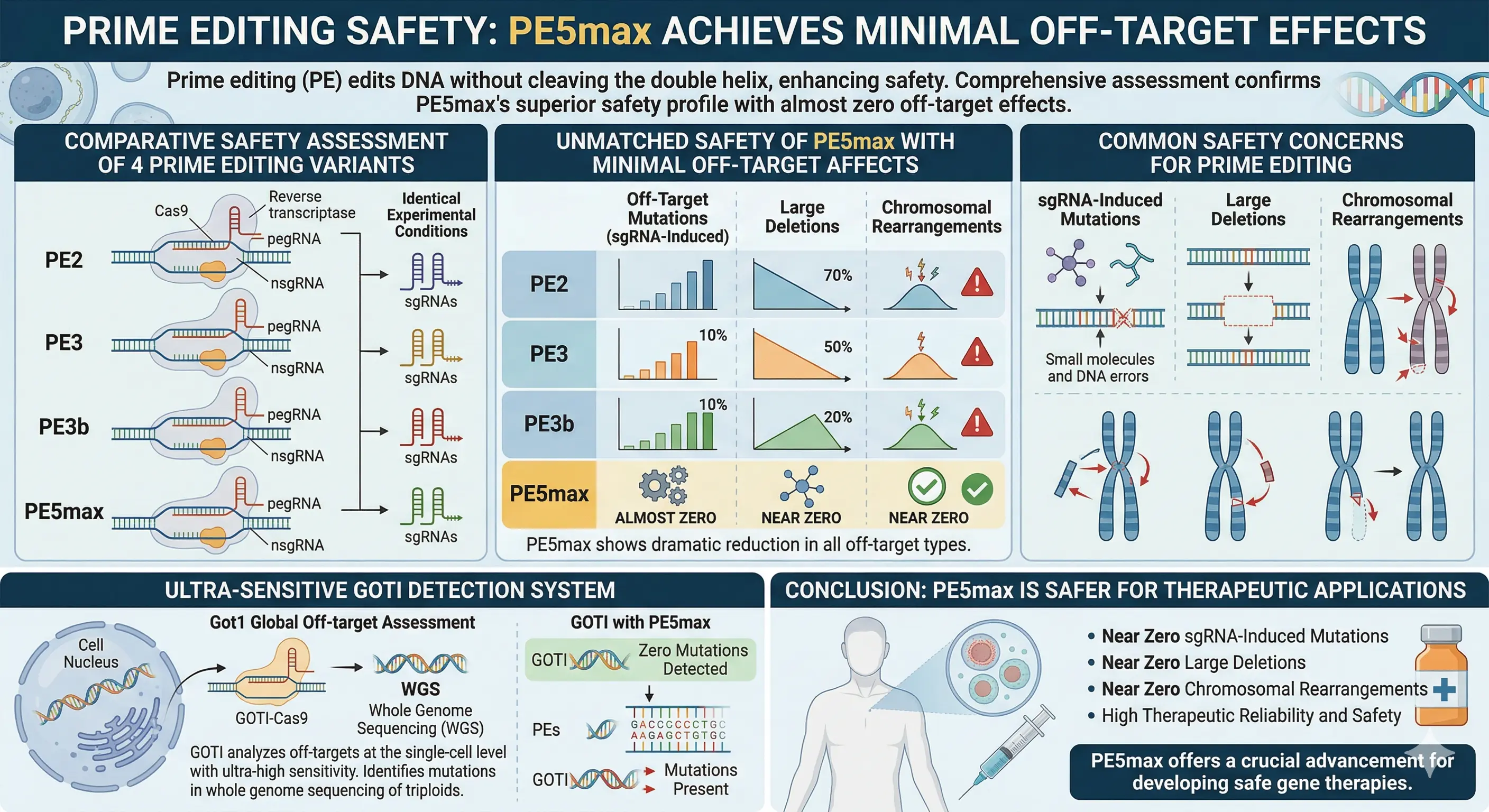
Safety of an editing technology that avoids double-strand breaks
Among four editors compared at three targets in human-derived HEK293T cells, the prime editor PE5max had the highest mean editing efficiency. In an evaluation of PE5max in mouse embryos, no increase in genome-wide single-nucleotide variants was detected within the sensitivity of the assay. However, large deletions and insertions, as well as chromosomal translocations, were observed in cell experiments; these findings cannot be taken to mean there are no genetic abnormalities or therapeutic risks.
Prime editing (PE) induces desired sequence changes while avoiding DNA double-strand breaks. It does not leave DNA completely uncut: it uses an enzyme that nicks one strand, and PE3- and PE5-series editors induce an additional nick in the opposite strand. PE4- and PE5-series editors also include components that transiently inhibit DNA mismatch repair (MMR). The key question in this comparison was how these efficiency-enhancing designs affect off-target changes and cellular responses.
High editing efficiency alongside detected structural variants
The researchers compared PE2max, PE3max, PE4max, and PE5max under the same conditions in HEK293T cells. Across three targets, PE5max had the highest mean editing efficiency, at 60.63%, and a small insertion/deletion (indel) frequency of 1.15%. The corresponding values for PE3max were 46.90% and 1.83%. At 12 predicted off-target candidate sites for one target, none of the four editors showed a significant editing difference from the control. This result is limited to the candidate sites tested and does not guarantee safety at all off-target locations.
Primer-extension-mediated sequencing (PEM-seq), used to assess structural variants, revealed a different pattern. The analysis assessed deletions larger than 100 base pairs, insertions larger than 20 base pairs, and chromosomal translocations. For PE5max, the frequencies of large deletions and large insertions were 0.78% and 0.72%, respectively—lower than the 2.29% and 1.53% for PE3max—but both types of variant increased significantly relative to the control. PE5max also had a chromosomal translocation frequency of 0.17%, higher than the control. The frequencies of large deletions for PE2max and PE4max were each 0.02%, so there is no basis for saying that PE5max caused fewer structural variants than every comparator.
In mouse embryos, the researchers injected editing components into one cell of a two-cell-stage embryo and used GOTI analysis to compare the injected-cell lineage with the internal control-cell lineage in the same embryo. Whole-genome analysis of cells isolated at embryonic day 14.5 found 5–18 single-nucleotide variants (SNVs) per embryo, similar to the background level in controls injected with Cre alone. The researchers interpreted this as no detectable increase in genome-wide off-target SNVs attributable to PE5max within the sensitivity of the assay.
Long-term safety questions remain for therapeutic evaluation
RNA sequencing (RNA-seq) also found no significant increase in the number of RNA SNVs in editor-treated groups. However, all four editors altered transcriptional signals related to innate immunity and inflammation, with activation of the nuclear factor kappa B (NF-κB) pathway in particular. The researchers proposed that this could reflect cellular stress from delivery of exogenous editing components; the result does not establish inflammatory side effects in patients.
The study focused mainly on short-term results from a single transformed cell line and mouse embryos. HEK293T is a cell line with defective MMR function, so it is uncertain whether the same results would apply to normal cells or disease-relevant cells. The number of embryos studied was also limited. GOTI is not optimized to comprehensively assess large structural variants or epigenetic changes. The functional effects of the observed translocations and the long-term risks of transient MMR inhibition also remain open questions. PE5max’s efficiency and the SNV analysis support further development, but assessing therapeutic safety will require additional validation in disease-relevant cells and long-term animal models.
The study’s methods and results are available in the full text of the Cells paper.
Prime editing (PE) represents a precise genome-editing approach that avoids double-strand breaks, promising significant advancements in clinical and agricultural sectors. Despite its potential, concerns persist regarding its genome-wide off-target effects. This study systematically evaluated four PE variants (PE2max, PE3max, PE4max, and PE5max) through PEM-seq and RNA-seq analyses, supplemented by ultra-sensitive GOTI testing for PE5max. Findings indicate that PE5max showed no detectable sgRNA-driven off-target single-nucleotide variants (SNVs) in GOTI assays and exhibited only minor large deletions and chromosomal translocations. This comparative analysis under controlled conditions highlights PE5max's superior specificity, supporting its enhanced safety for therapeutic use.
When choosing a gene editor for therapeutic use, comparing only the correction rate at the target sequence can miss differences in safety. In this study, PE5max showed high editing efficiency, but large deletions, insertions, and translocations were observed, independently of the finding that no increase in SNVs was detected. For example, a development team considering PE5max for disease-relevant cells could measure target correction and structural variants together, while separately tracking changes in immune and inflammatory signals and long-term genomic stability after MMR inhibition. Because results from HEK293T cannot readily be applied directly to normal cells, evaluation tailored to the intended application is needed. This comparison helps define evaluation criteria; it does not establish efficacy or clinical safety in patients.