Beyond Unit Cell Repetition: Reaction-Diffusion Morphogenesis Enables Irregular Lattices with Enhanced Strength and Toughness
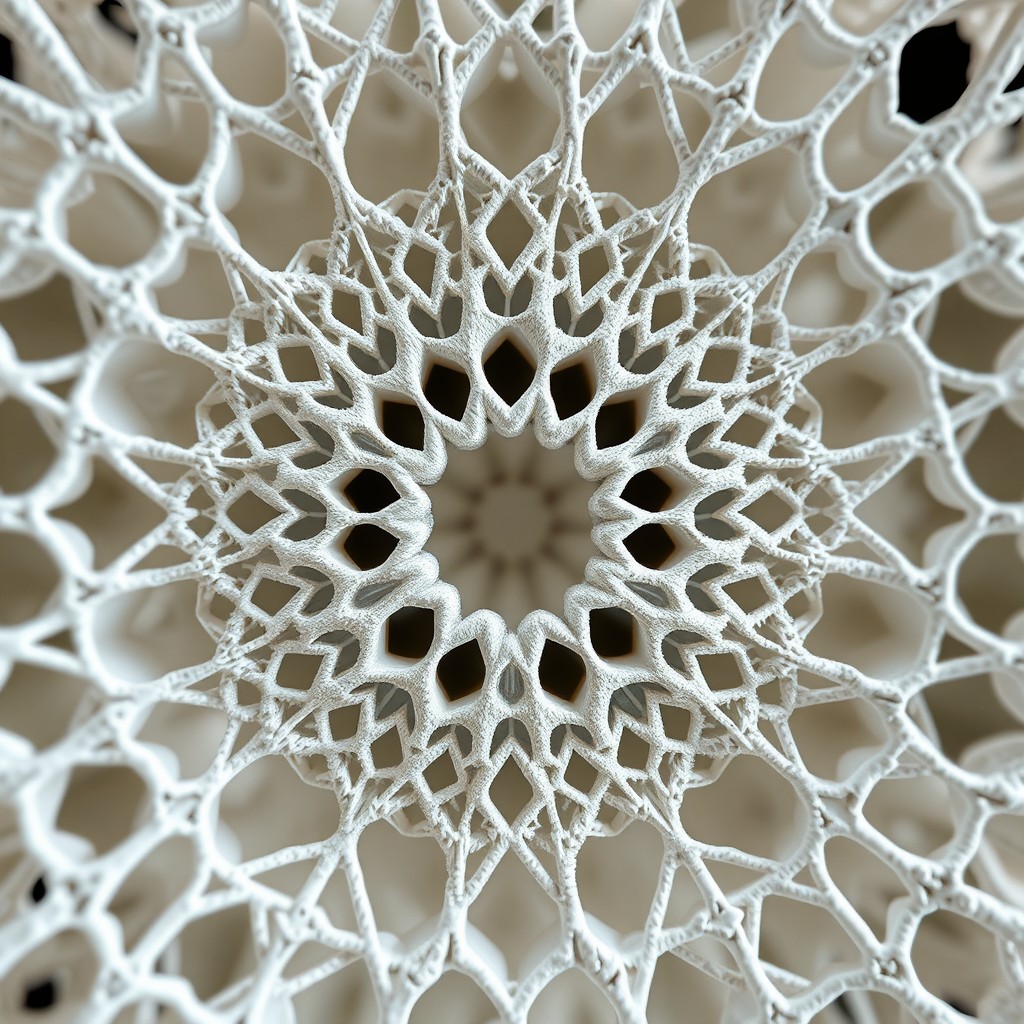
Background
Architected materials derive their functionality from the geometric arrangement of their constituent elements. From lightweight structures to energy-absorbing designs and auxetic behavior, the geometry of the lattice dictates its performance. However, conventional design approaches have been constrained by the periodic repetition of predefined unit cells.
While this approach ensures uniform properties, it struggles to implement region-specific functionalities within a single component or adapt to complex geometries. Furthermore, the presence of defects can lead to catastrophic failure, as cracks propagate linearly along the regular lattice. In contrast, biological tissues exhibit a fundamentally different approach. Bone, wood grain, and trabecular bone are characterized by morphogenesis—the non-linear interaction of local growth rules—resulting in irregular yet mechanically superior structures. Can this principle be translated to the design of engineering materials?
Key Findings
The study, published in PNAS 123, Issue 27, introduces RDGenCAD, a morphogenesis-based design framework. This system transforms programmable growth rules into reaction-diffusion (RD) dynamics and directly generates CAD-compatible, self-organizing structures. The researchers directly applied the RD mechanism—proposed by Alan Turing, where the competitive diffusion of activator and inhibitor molecules leads to spontaneous pattern formation—to the design of material lattices.
The research team constructed a database of 120,000 morphogenesis-generated structures and systematically analyzed their elastic properties. The resulting structures exhibited significant geometric irregularity while enabling continuous and statistically deterministic tuning of the elastic modulus. This encompasses a wide range, from auxetic regions exhibiting negative Poisson's ratio to conventional regions with positive Poisson's ratio.
Notably, the structures demonstrated emergent flaw insensitivity through a stress compartmentalization mechanism, deflecting crack paths in the presence of defects. Cracks dissipate energy along the complex boundaries of the irregular lattice, preventing linear propagation. Consequently, the structures exhibited a synergistic improvement in both strength and toughness compared to a regular lattice of the same density. This breaks the conventional trade-off between strength and toughness.
Significance and Implications
This research challenges the fundamental assumptions in the design of architected materials. The study provides compelling evidence, through a large-scale database of 120,000 structures, that biological self-organization offers a viable engineering alternative to the decades-old paradigm of unit cell repetition. Contributed by Huajian Gao, reviewed by Grace Gu and Carlos M. Portela, and published in July 2026.
The enhanced strength-toughness synergy and flaw insensitivity have immediate implications for applications requiring damage-tolerant designs, such as aerospace structures, orthopedic implants, and impact-absorbing devices. The ability to continuously tune elastic properties by adjusting RD parameters also makes it suitable for designing functionally graded materials with region-specific mechanical requirements.
Remaining challenges include expanding the current database, which focuses on 2D structures, to 3D complex geometries and verifying compatibility with large-scale additive manufacturing processes. The quantitative design rules relating RD parameters to macroscopic mechanical performance also require further refinement in subsequent research.
Proceedings of the National Academy of Sciences, Volume 123, Issue 27, July 2026. SignificanceMost architected materials are designed by repeating predefined unit cells, an approach that limits their ability to integrate functional heterogeneity, adapt to complex geometries, or remain robust in the presence of defects. In contrast, ...
The most direct application of RDGenCAD is in the additive manufacturing (3D printing) of customized structural components. For components with varying load conditions across different locations, such as aircraft fuselage panels or bone implants, the RD parameters can be adjusted regionally to create a continuous structure with both auxetic and high-stiffness regions. Conventional design methods require joining different unit cells, leading to stress concentrations at the interfaces. The morphogenesis approach avoids this problem by allowing the structure to transition naturally.
The flaw insensitivity can enhance the safety margins in environments where micro-cracks are inevitable, such as turbine blade protection structures subjected to fatigue loading or helmet liners designed for impact absorption. The database of 120,000 structures also holds significant potential as a training dataset for machine learning-based inverse design.