Successful Gene Editing for Spinocerebellar Ataxia Type 3 via EV Delivery
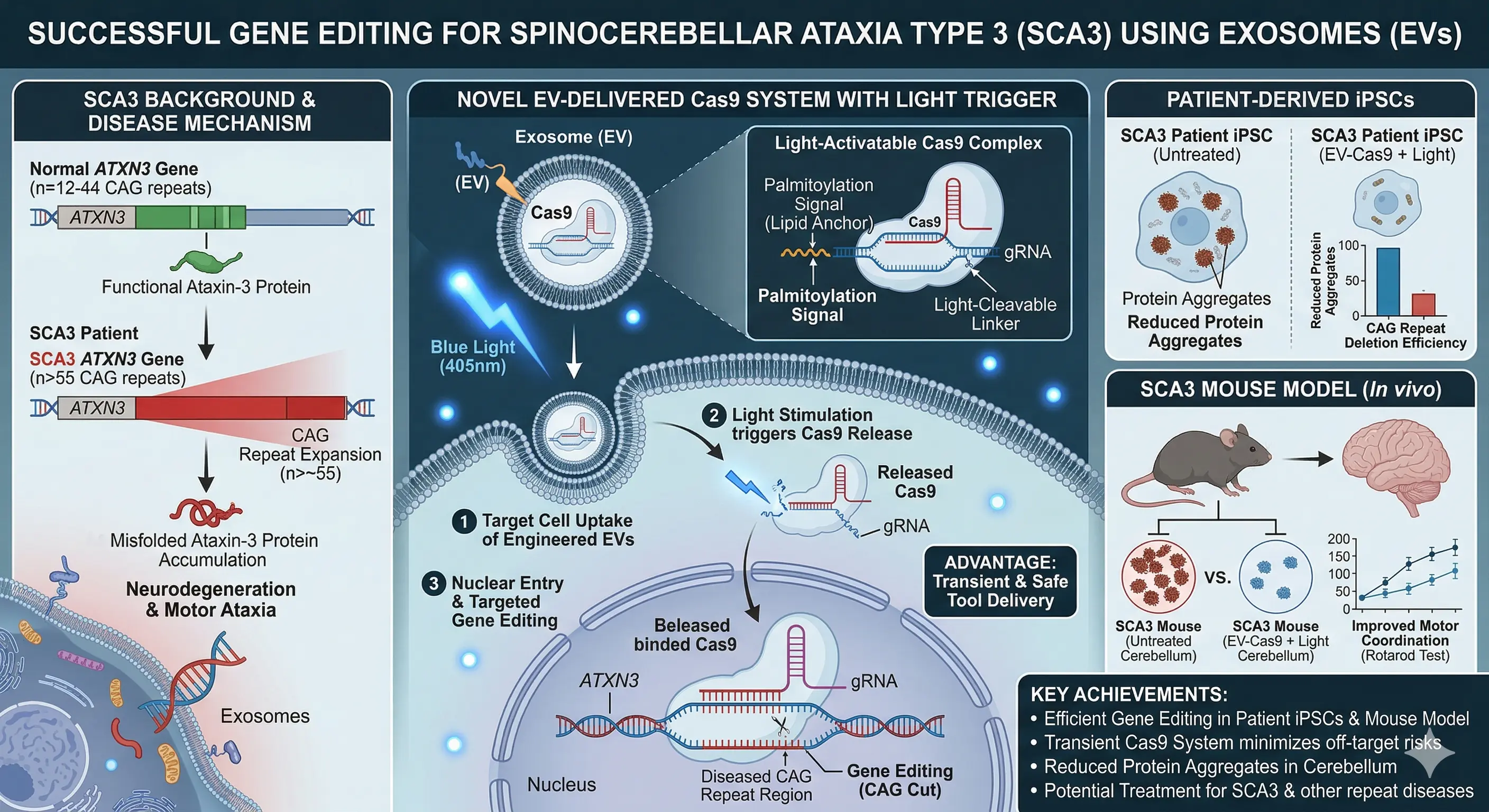
Spinocerebellar ataxia type 3 is a disease caused by the expansion of CAG repeats in the ATXN3 gene. Researchers attached a fatty acid modification signal and a photocleavable linker to Cas9, which was then loaded into extracellular vesicles (EVs). Upon light exposure, Cas9 was released, effectively cutting the diseased gene. This approach showed promise in patient-derived iPSCs and mouse models, offering a new delivery method for gene editing tools.
Spinocerebellar Ataxia Type 3 (SCA3) is a neurodegenerative disorder caused by an overexpansion of a CAG tract within the ATXN3 gene, leading to toxic properties of the ataxin-3 protein. Genome editing using CRISPR-Cas9 enzymes is a promising strategy to inactivate mutant ATXN3 alleles; however, in vivo delivery remains a challenge. Extracellular vesicles (EVs) are promising vehicles for delivering Cas9 and single guide RNA (sgRNA) ribonucleoproteins, minimizing genomic exposure to highly active endonucleases. In this study, researchers designed SpCas9 with a palmitoylation motif, enabling SpCas9 and sgRNA enrichment into EVs. The introduction of a photocleavable linker, PhoCl, allowed for the photo-inducible release of SpCas9 from the palmitoylation motif in EVs, increasing target engagement to ATXN3 in vitro. EVs loaded with SpCas9 ribonucleoproteins resulted in ATXN3 knockout in SCA3 patient-derived iPSCs and two SCA3 animal models. These findings highlight an innovative route for the transient delivery of gene editing tools, providing a promising therapeutic platform for the treatment of genetic diseases, including SCA3, as reported in Nature Medicine.
A new delivery system for gene therapy of neurological disorders emerges