mRNA 치료, 망막 신경퇴행성 질환의 전임상 가능성과 과제
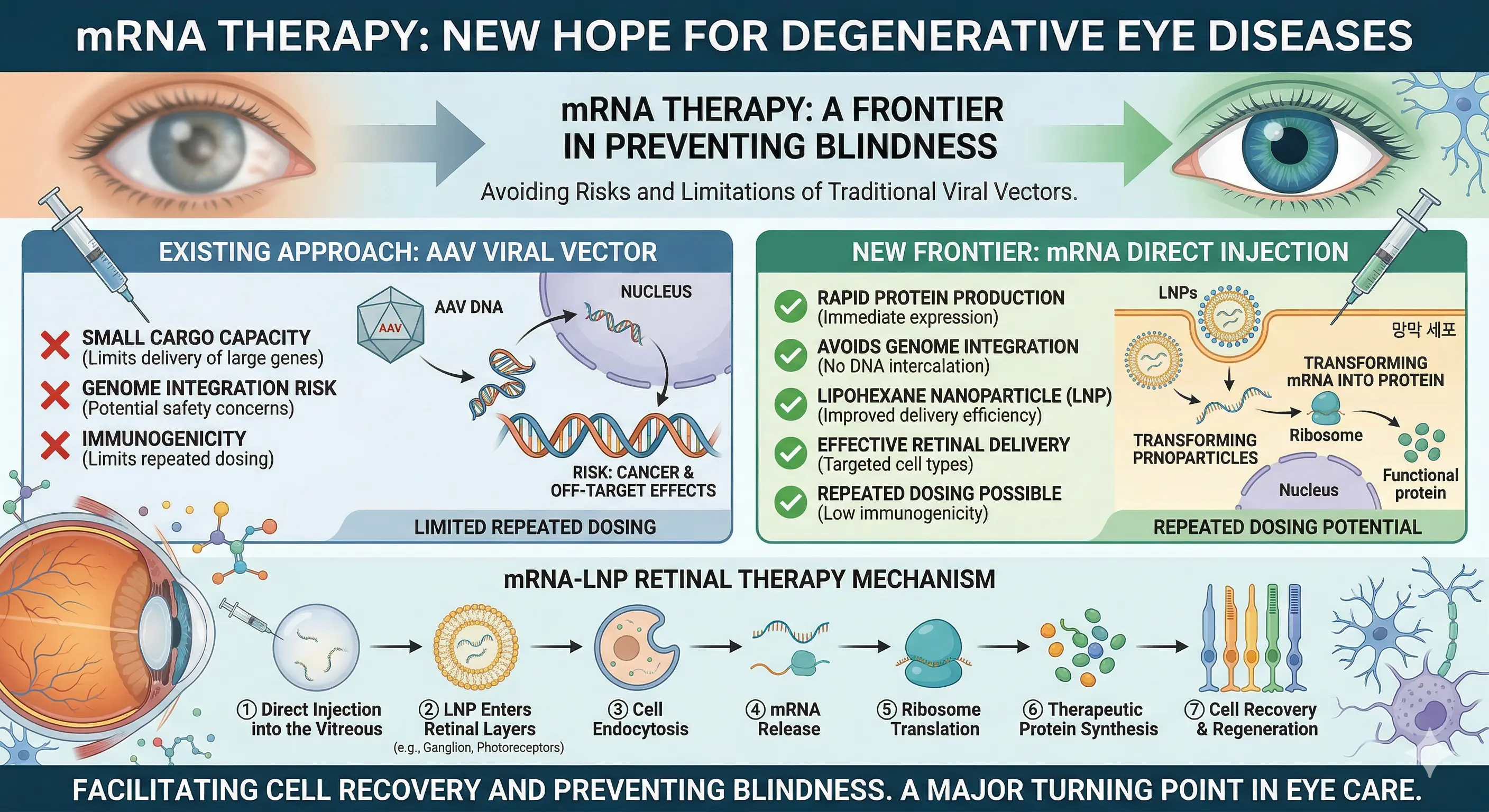
망막 신경퇴행과 mRNA 치료의 가능성
망막 신경퇴행성 질환에서 메신저 RNA(mRNA) 치료가 신경보호와 병적 혈관신생 억제에 활용될 가능성을 다룬 리뷰가 나왔다. 다만 리뷰가 정리한 치료 효과의 근거는 전임상 연구에 머문다. 초록에 따르면 망막 임상시험에 진입한 후보는 아직 없는 상태다.
망막 신경퇴행은 비가역적 시력 손실의 주요 원인이며, 현재 치료의 효과에도 한계가 있다. 아데노연관바이러스(AAV) 기반 유전자 전달은 임상적 가능성을 보였지만, 안전성과 효능, 실을 수 있는 유전물질의 크기가 제약으로 꼽힌다. 대안으로 연구되는 mRNA는 유전체에 삽입되지 않으면서 빠르게 단백질을 발현시키는 방식이다.
지질 나노입자 전달과 전임상 관찰
학술지 Neural Regeneration Research의 이 리뷰는 망막 적용을 위한 mRNA 설계, 전달체와 투여 경로의 발전을 정리했다. 지질 나노입자(LNP)를 비롯한 전달체는 안구 내 투여에서 mRNA의 안정성과 세포 도입 효율을 높이고, 망막 신경세포·뮐러 교세포·망막색소상피로 전달하는 데 활용됐다.
전임상 연구에서는 유전자 편집 도구, 전사인자, 기능을 보충할 단백질을 발현시키는 용도로 mRNA를 사용한 사례가 있다. 리뷰는 시신경 압궤와 레이저 유도 맥락막 신생혈관 등의 모델에서 신경보호와 병적 혈관신생 억제 결과를 소개한다. 해당 모델에서 양호한 안구 안전성도 보고됐으나, 사람의 시력 회복이나 실명 예방 효과를 입증한 결과는 아니다.
반복 투여 전략과 임상 적용의 간극
리뷰는 mRNA의 일시적 발현과 상대적으로 낮은 면역원성이 반복 투여 전략을 뒷받침한다고 설명한다. 그러나 반복 투여의 임상 안전성이나 장기 효능이 확립됐다는 뜻은 아니다. 초록에는 개별 연구의 투여 간격, 효과 크기와 세포별 전달률이 제시되지 않았다.
연구진이 제안하는 방향은 질환 단계에 맞춘 반복적·다중 표적 개입이다. 신경보호, 축삭 재생, 신경혈관 조절을 지원하는 전략이지만, 복잡한 망막 질환에 맞춘 구체적 접근은 아직 충분히 탐구되지 않았다. 전임상 가능성이 실제 치료로 이어질지는 후속 검증이 필요하다.
연구 내용은 Europe PMC에 수록된 리뷰 초록과 서지정보에서 확인할 수 있다.
Retinal neurodegeneration remains a major cause of irreversible vision loss, yet current therapeutic options are limited in effectiveness. Although gene therapies have shown clinical potential, the overexpression platforms they rely on, such as adeno-associated virus DNA, are constrained by safety concerns, limited efficacy, and cargo size restrictions. In contrast, mRNA therapy has gained recognition as a compelling alternative, enabling rapid and efficient protein expression without the risk of genomic integration. This review synthesizes recent advances in mRNA engineering, delivery systems, and administration routes for retinal applications, and highlight strategies to enhance targeting, penetration, and controlled release through interdisciplinary collaboration between ophthalmology and bioengineering. In recent years, engineered mRNA formats, including chemically modified linear, circular, and self-amplifying RNA, can achieve higher translation efficiency within a tunable expression window. The transient nature and relatively low immunogenicity of in vitro transcribed mRNA support repeat dosing without insertional mutagenesis. Advances in nanocarriers, particularly lipid nanoparticles, have enabled preferential delivery to retinal neurons, Müller glia, and pigment epithelium via intraocular administration, while improving mRNA stability and transfection efficiency. In preclinical studies, mRNA has been widely used to deliver gene-editing tools, transcription factors, and supplementary functional proteins. In disease models such as optic nerve crush and laser-induced choroidal neovascularization, mRNAbased therapies enhance neuroprotection and suppress pathological angiogenesis in the injured retina, with favorable ocular safety profiles. However, it remains largely unexplored how the intrinsic advantages of mRNA therapy can be leveraged to develop tailored strategies for complex retinal disorders. Consistent with this gap, mRNA platforms have not yet been wide
mRNA의 일시적 단백질 발현은 망막 질환의 진행 단계에 맞춰 치료 표적과 투여 시점을 조정하는 연구 전략으로 검토할 수 있다. 예를 들어 신경보호나 축삭 재생에 필요한 단백질을 발현시키려면, 해당 세포에 도달하는 전달체와 적절한 발현 기간을 함께 평가해야 한다. 이 리뷰의 의미는 이런 전달체 선택과 실험 설계에 참고할 사례와 접근법을 정리했다는 데 있다. 다만 환자에게 적용할 치료법으로 확립된 것은 아니다. 리뷰 초록 기준으로 망막 임상시험에 진입한 후보가 없으며, 반복 투여의 안전성과 지속적인 치료 효과는 별도 검증 과제로 남는다.