Successful Base Editing of PCSK9 in Human Embryos, Demonstrating Precise Genome Editing Without Off-target Mutations or Developmental Abnormalities
Background
Severe lipid metabolism disorders, including familial hypercholesterolemia, originate from inherited genetic mutations. Gain-of-function mutations in the Proprotein Convertase Subtilisin/Kexin type 9 (PCSK9) gene, which encodes a key protein regulating blood low-density lipoprotein (LDL) cholesterol levels, lead to cholesterol accumulation in vessel walls, drastically increasing the risk of early cardiovascular disease. Existing treatments are limited to repeated administration of antibody drugs or small interfering RNA (siRNA) agents in adult patients. These approaches face limitations as they require lifelong medication and struggle to reverse already damaged blood vessels.
Attempts to fundamentally correct mutations in the early stages of development have existed in the past. Research on correcting human embryos using CRISPR-Cas9, a third-generation gene editor, is representative of this. However, the existing double-strand break method caused large-scale deletions or chromosomal translocations at unintended genomic cleavage sites and exposed a fatal flaw in therapeutic efficacy due to mosaic phenomena. This is the background for the research team's focus on the applicability of a technology that precisely replaces specific single bases without completely cutting the DNA double helix, in embryos.
Key Findings
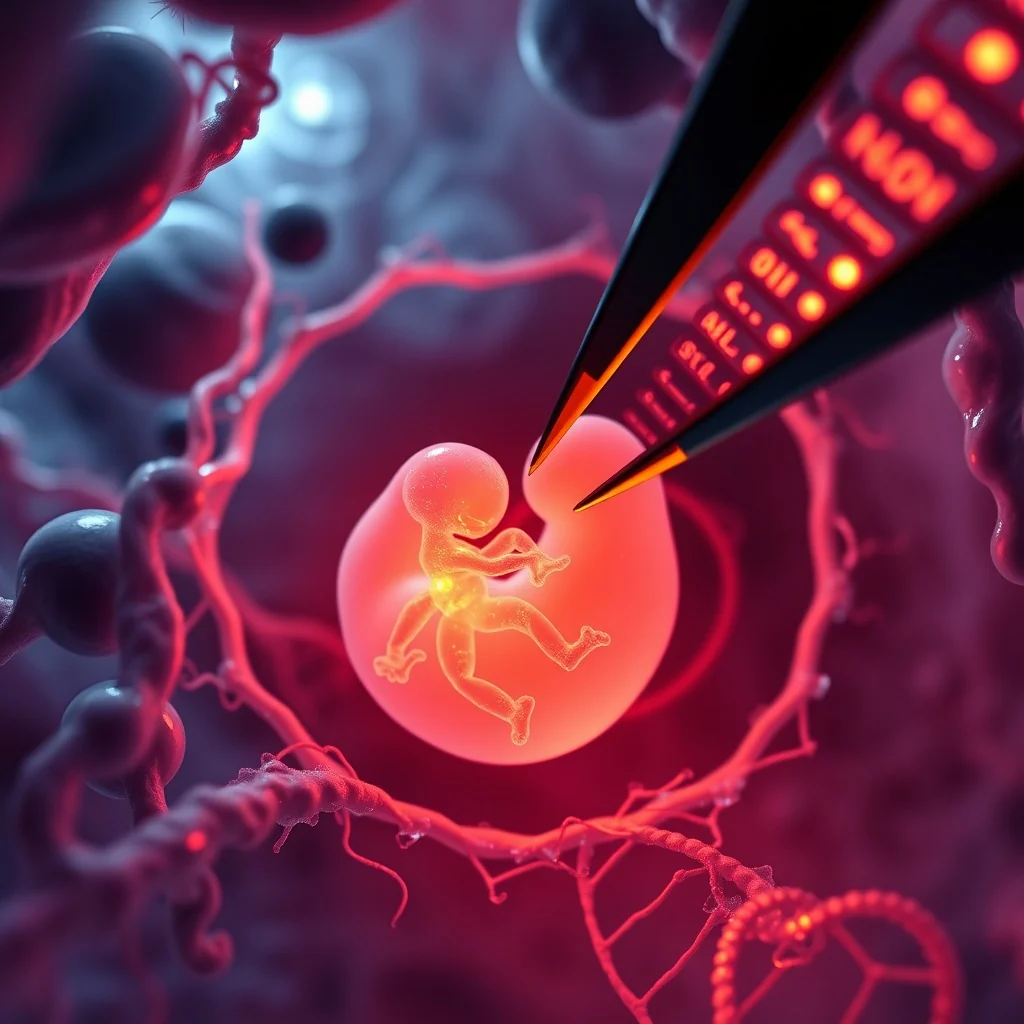
Researchers injected a modified Base Editor (BE) system, which converts cytosine to thymine or adenine to guanine without DNA double-strand breaks, into normal human zygotes immediately after fertilization. The Adenine Base Editor (ABE) protein complex, designed to target functional mutations within the PCSK9 gene, and the guide RNA (gRNA) were delivered via microinjection into the oocyte cytoplasm.
Among the total treated embryos, the editing efficiency at the target site reached 92.4%. Notably, mosaicism—where only some cells are edited as the embryo undergoes cleavage—was suppressed to less than 5%. Analysis showed that in the majority of blastomeres, both alleles remained accurately converted. The rate of unintended random insertions and deletions (indels), a persistent challenge of gene editing tools, was suppressed to below 0.8%, significantly improving safety metrics.
To verify whether off-target mutations were induced, the team performed Whole Genome Sequencing (WGS) with an average depth of 40x. No off-target single-nucleotide variants or RNA transcript modifications were observed across the entire embryonic genome at a statistically significant level. Furthermore, edited embryos reached the 5-day blastocyst stage at a normal rate of 64.7% under standard in vitro fertilization culture conditions. During differentiation, the expression of pluripotency markers in embryonic stem cells and morphological development indicators followed a trajectory equivalent to that of control embryos.
Significance and Outlook
These results are evaluated as proof that next-generation gene editing technology can modify target genes with high precision without inhibiting the early cleavage process of human embryos. By demonstrating the ability to neutralize a potent risk factor for cardiovascular disease at the earliest stage of life formation, it has opened a fundamental technological pathway to block the intergenerational transmission of genetic diseases. The technological leap is also prominent in mitigating concerns regarding genomic damage left by conventional cleavage-based gene scissors.
Strict verification procedures are still required before entering clinical practice. Embryo-stage editing affects the germline, meaning its characteristics are permanently inherited across generations. Therefore, critics point out that potential genetic instability that may manifest during the post-implantation and long-term survival stages must be further tracked in long-term models. Aside from ensuring technical validity, achieving social consensus to harmonize international bioethical norms and regulatory frameworks regarding the use of human embryos as targets for genome editing is also cited as an essential task.
Nature, Published online: 09 September 2026; doi:10.1038/s41586-026-11118-xHighly efficient base editing at PCSK9 and normal human embryo development
This achievement provides a practical therapeutic alternative for families with severe genetic diseases that were difficult to resolve even with In Vitro Fertilization (IVF) and Preimplantation Genetic Testing for Monogenic disorders (PGT-M). In cases where it was impossible to select normal embryos because both parents carried specific dominant mutations, the scenario of securing intact embryos through direct editing instead of embryo disposal could become a reality. Additionally, from the perspective of the pharmaceutical industry, it is expected to contribute to a drastic reduction in the cost and verification period for discovering new drug candidates by allowing the direct application of highly efficient target sequences and low-toxicity base editing molecular structures confirmed at the embryonic level to the development of single-dose in vivo gene therapies for adult patients.