💡필독
LNP 기반 폐 유전자 전달: 이식 면역 조절을 위한 정밀 최적화와 안전성 확보
The Journal of thoracic and cardiovascular surgery·2026년 4월 14일AI 큐레이션
✨AI 요약 (Beta)Beta
1. 연구 배경: 바이러스 없는 폐 이식 면역 조절
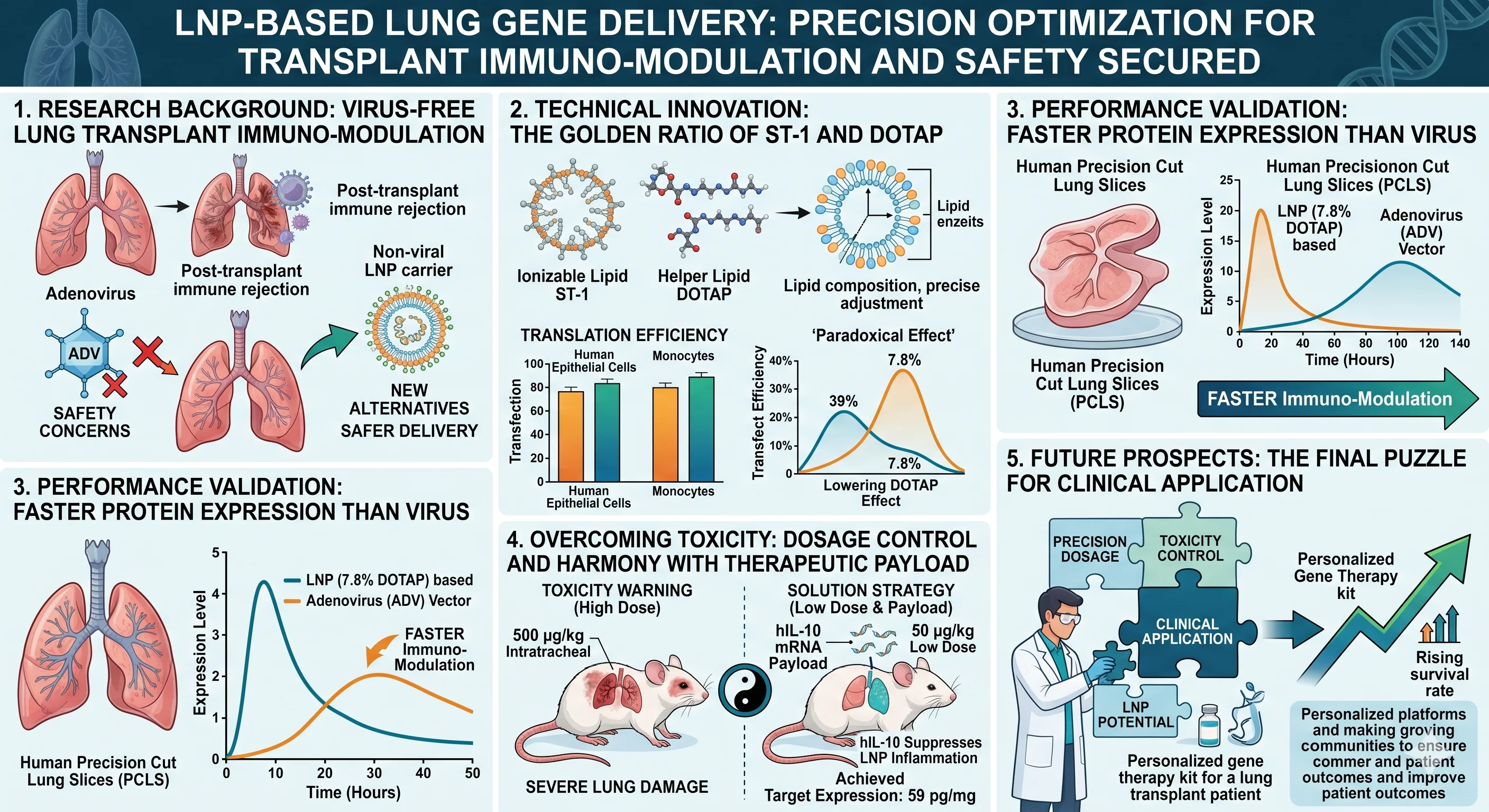
폐 이식 후 발생하는 면역 거부 반응을 억제하기 위해 공여자 폐에 직접 유전자를 전달하는 연구가 활발합니다. 기존에는 아데노바이러스(ADV)가 주로 쓰였으나, 안전성 문제로 인해 비바이러스성 전달체인 LNP(지방질 나노입자)가 새로운 대안으로 떠오르고 있습니다.
2. 기술적 혁신: ST-1과 DOTAP의 황금 비율
연구팀은 다양한 이온화 지방(Ionizable lipid) 후보 중 ST-1에 주목했습니다. 특히 보조 지방인 DOTAP의 비율을 정밀하게 조정하여 전달 효율을 극대화했습니다.
* 최적화 결과: 인간 폐 상피세포와 단핵구에서 90% 이상의 압도적인 전이율을 기록했습니다.
* 비율의 묘미: DOTAP 농도를 39%에서 7.8%로 낮추었을 때 오히려 전이 효율이 향상되는 '역설적 효과'를 확인하며 최적의 조합을 찾아냈습니다.
3. 성능 입증: 바이러스보다 빠른 단백질 발현
인간 정밀 폐 조직 절편(PCLS) 모델 실험에서 LNP 시스템의 성능이 입증되었습니다.
* 속도의 차이: 최적화된 ST-1 DOTAP(7.8%) 기반 LNP는 기존 아데노바이러스 벡터보다 훨씬 빠르게 발현 피크에 도달했습니다. 이는 이식 직후 급박한 면역 조절이 필요한 상황에서 매우 큰 장점이 됩니다.
4. 독성 극복: 용량 조절과 치료적 페이로드의 조화
LNP 투여 시 발생할 수 있는 폐 손상 문제는 이번 연구의 핵심 경고이자 해결 과제였습니다.
* 독성 경고: 쥐 모델 실험에서 500\mu g/kg의 고용량을 기관지 내로 투여했을 때 심각한 폐 손상이 관찰되었습니다.
* 해결 전략: 하지만 항염증성 사이토카인인 hIL-10 mRNA를 50\mu g/kg의 저용량으로 투여하자, LNP 자체의 염증 반응은 억제하면서도 목표한 수준의 단백질 발현(59 pg/mg)을 달성하는 데 성공했습니다.
5. 전망: 임상 적용을 위한 마지막 퍼즐
이번 연구는 LNP가 바이러스 벡터를 대체할 수 있는 강력한 잠재력을 가졌음을 보여주는 동시에, 임상 적용 전 '정밀한 용량 설정'**과 '독성 제어'가 필수적임을 시사합니다. 향후 폐 이식 환자의 생존율을 높이는 맞춤형 유전자 치료 플랫폼으로의 발전이 기대됩니다.
OBJECTIVE: To evaluate the efficiency and protein expression profiles of newly synthesized lipid nanoparticles (LNPs) as a nonviral vector gene delivery platform for gene editing of donor lungs for immunomodulation. METHODS: mCherry mRNA was formulated with 10 LNP candidates (5 ionizable lipids × 2 helper lipids), and gene delivery efficiency in cell lines was assessed using flow cytometry. The most promising LNP was optimized, and its protein expression was compared with that of adenoviral vectors (ADVs) using an mCherry enzyme-linked immunosorbent assay ELISA in a human precision-cut lung slice (PCLS) model. Additionally, intratracheal administration in a rat in vivo model was used to evaluate the relationship between LNP dose and protein expression using mCherry and human interleukin-10 (hIL-10) mRNA. RESULTS: An ionizable lipid ST-1 (formulated with 1,2-dioleoyl-3-trimethylammonium-propane [DOTAP]) achieved high transfection rates of 91.3 ± 6.9% in human lung epithelial cells and 88.4 ± 6.3% in human monocytic cells. Reducing the DOTAP content from 39% to 7.8% further improved the transfection rate. Peak mCherry expression in human PCLS with ST-1 DOTAP (7.8%) occurred at 2 days postadministration, which was faster than with adenoviral vectors. Intratracheal administration of 500 μg/kg of ST-1 DOTAP (7.8%) with mCherry to rat left lungs caused significant lung injury; however, 50 μg/kg of hIL-10 mRNA mitigated the LNP-induced lung inflammation, achieving the target concentration of 59 pg/mg protein in the left lung. CONCLUSIONS: LNPs achieved rapid and efficient protein expression in vitro and in vivo that exceeded the performance of viral vectors; however, significant lung injury was observed with intratracheal LNP administration. This findings underscores the need to further optimize LNP-mediated gene delivery to the lung before translation to the clinic.
💬왜 중요하냐면:
비바이러스 LNP는 기존 바이러스 벡터의 면역반응 문제를 피하면서 효율적인 유전자 전달을 가능하게 합니다. 이는 폐 이식 후 면역조절 치료를 안전하게 구현할 수 있는 새로운 길을 열어줍니다.
💬 댓글
0개의 댓글댓글을 작성하려면 로그인이 필요합니다
로딩 중...