🚀임상 연구
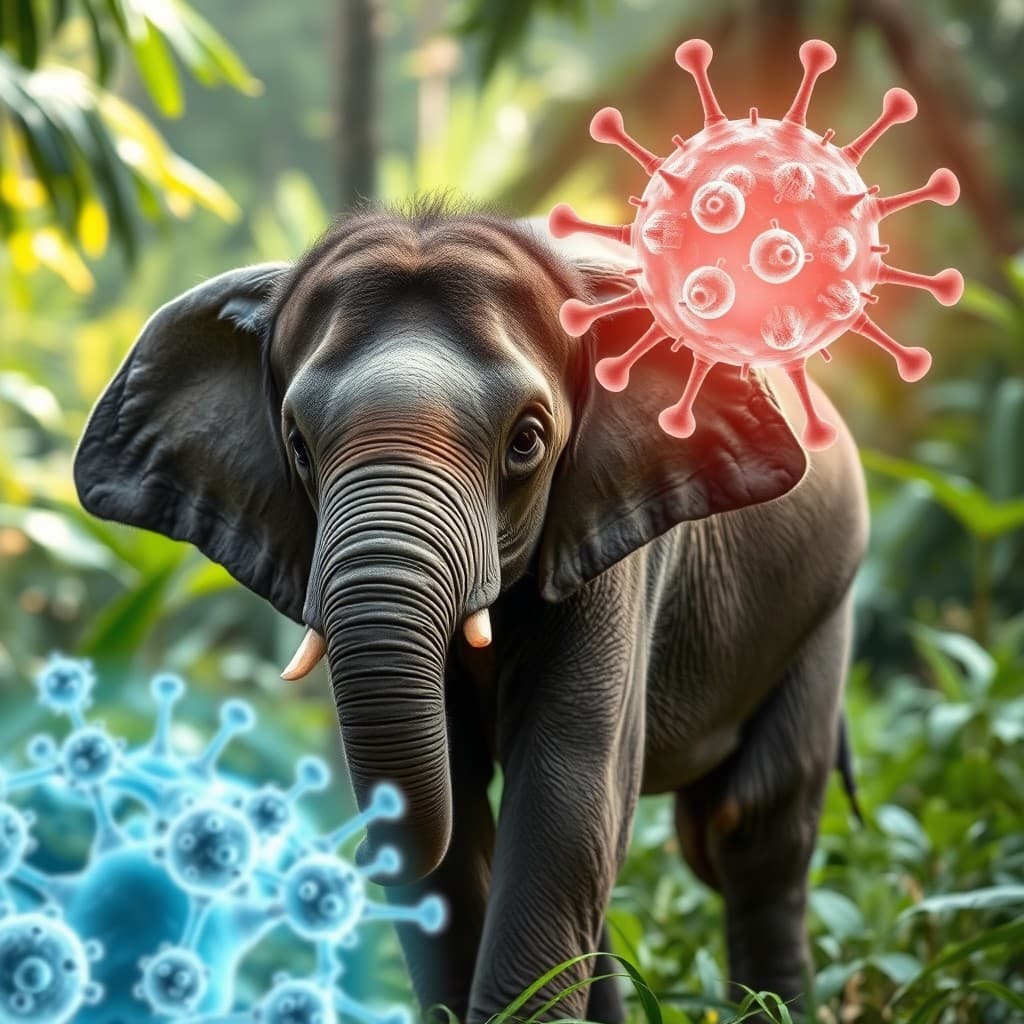
멸종위기 아시아코끼리 살리는 mRNA 백신, 치명적 헤르페스 감염 차단했다
Journal of virology·2026년 7월 29일AI 큐레이션
✨AI 요약 (Beta)Beta
## 배경
아시아코끼리(Asian elephant) 종 보존 과정에서 가장 큰 걸림돌은 어린 개체들을 죽음에 이르게 하는 급성 질환이다. 어미 항체가 감소하는 생후 수년 이내의 새끼 코끼리들이 주로 감염의 표적이 된다. 감염 시 내피세포가 파괴되면서 급성 출혈을 유발하는 코끼리 내피세포성 헤르페스바이러스 출혈성 질환(Elephant Endotheliotropic Herpesvirus Hemorrhagic Disease, EEHV-HD)으로 이어지기 마련이다. 이는 유소년기 아시아코끼리 사망 원인의 절반 이상을 차지하지만, 기존 의학으로는 예방할 백신조차 마땅치 않았다.
거대하고 복잡한 DNA 구조를 가진 헤르페스바이러스 특성 탓에 백신 개발이 번번이 난항을 겪었기 때문이다. 약독화 생백신은 안전성 우려가 컸고, 단백질 재조합 백신은 항체 유도 효능이 다소 부족했다. 이에 학계는 인류가 코로나바이러스 방어 과정에서 신뢰성을 확인한 메신저 리보핵산(mRNA) 플랫폼에 시선을 돌렸다. 신속한 면역 형성을 유도하면서도 바이러스 독성은 배제할 수 있는 새로운 해결책이 마련된 셈이다.
UNLABELLED: Juvenile Asian elephants who have lost maternal antibodies are particularly susceptible to fatal hemorrhagic disease caused by primary infection with elephant endotheliotropic herpesvirus 1A (EEHV1A). To address this vulnerability, a multi-antigen EEHV1A mRNA vaccine has been administered to EEHV1A seronegative calves at four institutions. However, the extent to which this vaccine confers protective immunity remains an open question. In November 2023, two juvenile male calves (aged 6 and 7 years) were transferred from Dublin Zoo to the Cincinnati Zoo and Botanical Garden and confirmed to be seronegative for EEHV1A. Both calves received an experimental EEHV1A mRNA vaccine in October 2024, followed by a booster dose in November. Post-vaccination serological responses were robust, with significant antibody production against vaccine-encoded glycoproteins (gB, gH, gL, and gO), although titers started to decline by day 102 post-booster. In February 2025, the younger calf developed EEHV1A viremia, followed by the older calf in March. Both maintained viral loads below 6,000 viral genome equivalents (VGE)/mL and exhibited no hematological abnormalities or clinical signs of disease. Serum collected post-viremia revealed sustained antibody titers against the four vaccine antigens, approaching levels observed in naturally infected elephants. Despite confirmed viremia, both calves remained clinically healthy, and viral loads resolved without therapeutic intervention. These findings suggest that immunity generated against the EEHV proteins encoding the conserved herpesvirus attachment fusion complex can confer protective immunity and mitigate disease severity following primary infection in juvenile elephants. IMPORTANCE: This study delivers an early demonstration of applying mRNA vaccination to a herpesvirus outside conventional laboratory models and, to our knowledge, the first such use in an endangered mammalian species. EEHV-HD is the leading cause of death in juv
💬왜 중요하냐면:
이 연구는 전 세계 동물원과 종 보존 기관에서 아시아코끼리 개체군을 보호하기 위한 즉각적인 실행 가이드라인을 제공한다. 동물원 간 개체 이동이나 합사 과정에서 스트레스로 인해 잠복해 있던 바이러스가 재활성화되어 주변의 감염 이력이 없는 새끼 코끼리들에게 전파되는 상황을 효과적으로 예방할 수 있다. 이동 전에 백신을 접종하도록 조치하면 감염 시 발생할 수 있는 폐사율을 대폭 낮추는 방어막을 구축하게 된다. 나아가 다중 항원 mRNA 기술은 코끼리뿐 아니라 헤르페스바이러스 감염증으로 고통받는 다른 멸종위기 포유류의 보전 연구에도 널리 접목될 수 있다. 야생동물 의학계와 보전 생물학계에 새로운 지평을 열어줄 플랫폼 기술로 안착할 전망이다.
💬 댓글
0개의 댓글댓글을 작성하려면 로그인이 필요합니다
로딩 중...