Albumin-Conjugated IL-15 Fusion Protein Overcomes the Blood-Brain Barrier Challenge in Glioblastoma Immunotherapy
Background
Glioblastoma (GBM) is the most aggressive malignant brain tumor in adults. Despite standard treatment with temozolomide combined with radiation therapy, the median survival remains around 15 months. Immune checkpoint inhibitors (ICIs) have shown remarkable success in melanomas and lung cancers, but have consistently failed in GBM. This is attributed to two structural barriers.
First, the blood-brain barrier (BBB) physically blocks the penetration of antibodies and cytokines into the brain parenchyma. Second, the GBM microenvironment itself maintains a strongly immunosuppressive state. Regulatory T cells (Treg) and myeloid-derived suppressor cells (MDSC) are densely populated around the tumor, and M2-polarized macrophages suppress anti-tumor immune responses. Interleukin-15 (IL-15) is a cytokine that strongly activates NK cells and CD8+ T cells and has been considered a promising candidate for enhancing anti-cancer immunity. However, its extremely short in vivo half-life makes it difficult to maintain effective concentrations with single-agent administration.
Key Findings
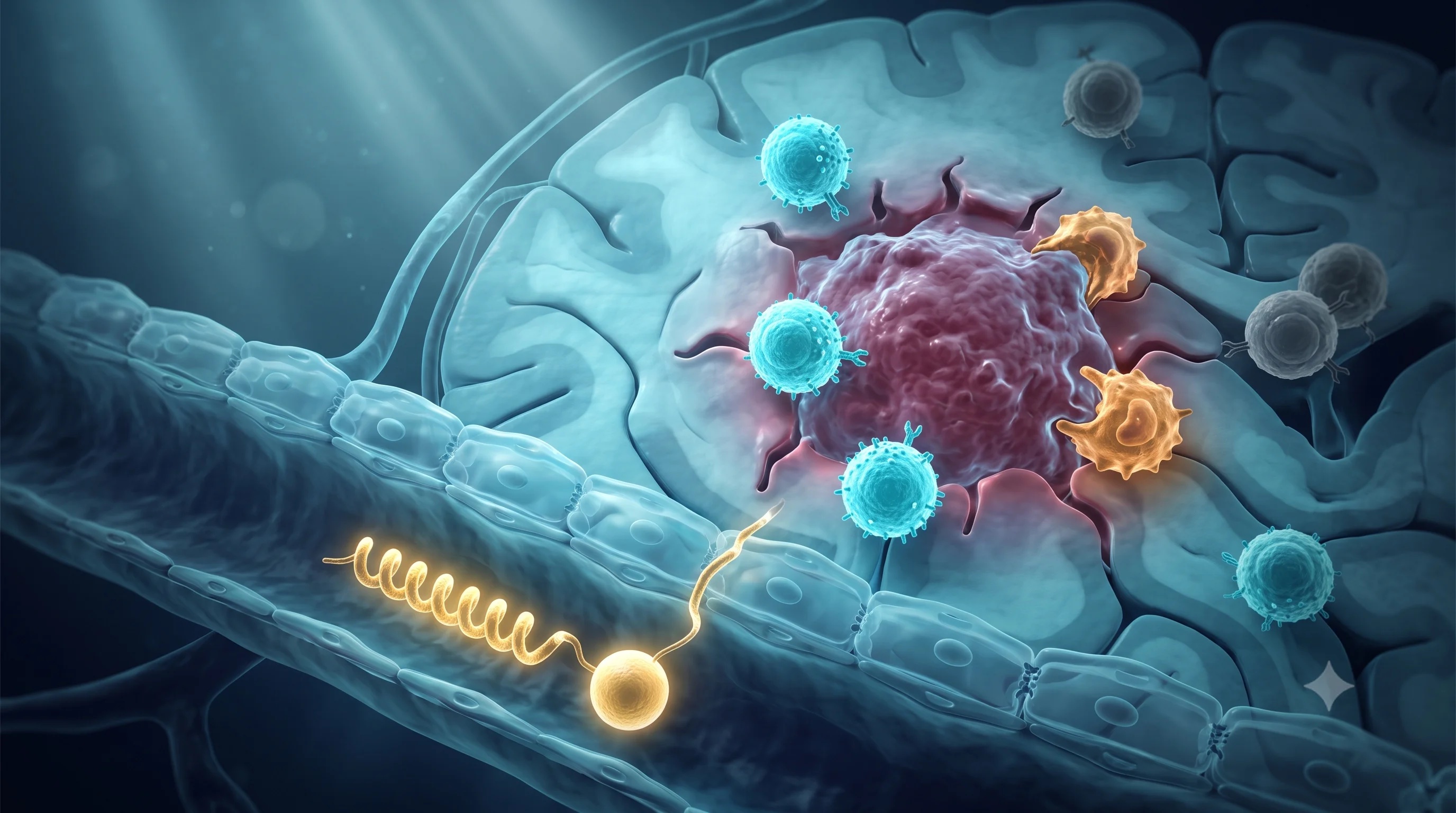
The researchers designed hIL-15-ABD, a recombinant human IL-15 fused with an albumin-binding domain (ABD). When ABD non-covalently binds to serum albumin, the molecular weight increases, reducing renal clearance and extending the half-life. Simultaneously, it utilizes the FcRn receptor-mediated transcytosis pathway of albumin to enhance BBB penetration, which is the core strategy.
A noteworthy finding is that hIL-15-ABD directly interferes with the FGF-2/FGFR1/2 signaling pathway. Fibroblast growth factor-2 (FGF-2) promotes GBM angiogenesis and tumor growth. hIL-15-ABD competitively inhibits the binding of FGF-2 to FGFR1/2, achieving a dual effect of immune activation and tumor growth inhibition.
The results of combination therapy in orthotopic GBM mouse models confirmed two key aspects. In C57BL/6 mice, the hIL-15-ABD and anti-PD-L1 combination group showed a significantly increased ratio of M1 macrophages in the tumor compared to the single-agent groups, and CD8+ cytotoxic T cell and NK cell activity were simultaneously enhanced. In humanized PD1+/+ mice, the combination with anti-PD-1 antibody reduced the frequency of Treg and MDSC, restoring anti-tumor immune responses. Both models showed prolonged survival in the combination group.
Significance and Outlook
This study demonstrates, at the preclinical level, that GBM immunotherapy can simultaneously address two major challenges—BBB penetration and conversion of the immunosuppressive microenvironment—with a single molecule. In particular, the unexpected mechanism of FGF-2 competitive inhibition suggests that IL-15-based therapeutics may expand their application beyond immune activation to include angiogenesis inhibition.
However, the limitations of the preclinical stage are clear. The structural differences between mouse and human BBBs, the fact that humanized mouse models do not fully recapitulate the immune system of actual patients, and the safety concerns regarding cytokine release syndrome associated with systemic administration of IL-15 remain challenges to be addressed before clinical translation. The dose-response relationship and long-term toxicity profile of FGF-2/FGFR pathway inhibition also need further investigation.
The study addresses glioblastoma's heterogeneity and immunosuppressive nature by developing hIL-15-ABD, a recombinant human IL-15 fused with an albumin-binding domain to extend half-life and improve blood-brain barrier penetration. Research demonstrates that this fusion protein significantly enhances anti-PD-L1 and anti-PD-1 therapies by increasing M1 macrophages, activating cytotoxic T cells, and promoting natural killer responses. The treatment also reduces immunosuppressive cells including regulatory T cells and MDSCs while targeting FGF-2/FGFR1/2 pathways. Testing in orthotopic models showed improved efficacy with both anti-PD-L1 in C57BL/6 mice and anti-PD-1 in humanized PD1+/+ mice.
ICI monotherapy is essentially not an option for GBM patients. If a long-acting cytokine such as hIL-15-ABD can increase the response rate to ICIs, it could add an immunotherapy combination to the current limited GBM treatment paradigm of surgery, radiation, and chemotherapy.
Industrially, the ABD fusion platform can be applied to other short half-life cytokines (IL-2, IL-21, etc.) besides IL-15, making it a modular design that can be expanded to the entire central nervous system tumor that requires BBB penetration. In the future, if human pharmacokinetic data and biomarkers of FGF-2 inhibition are established in Phase 1 clinical trials, it will provide practical evidence for GBM patient selection and combination therapy design.